
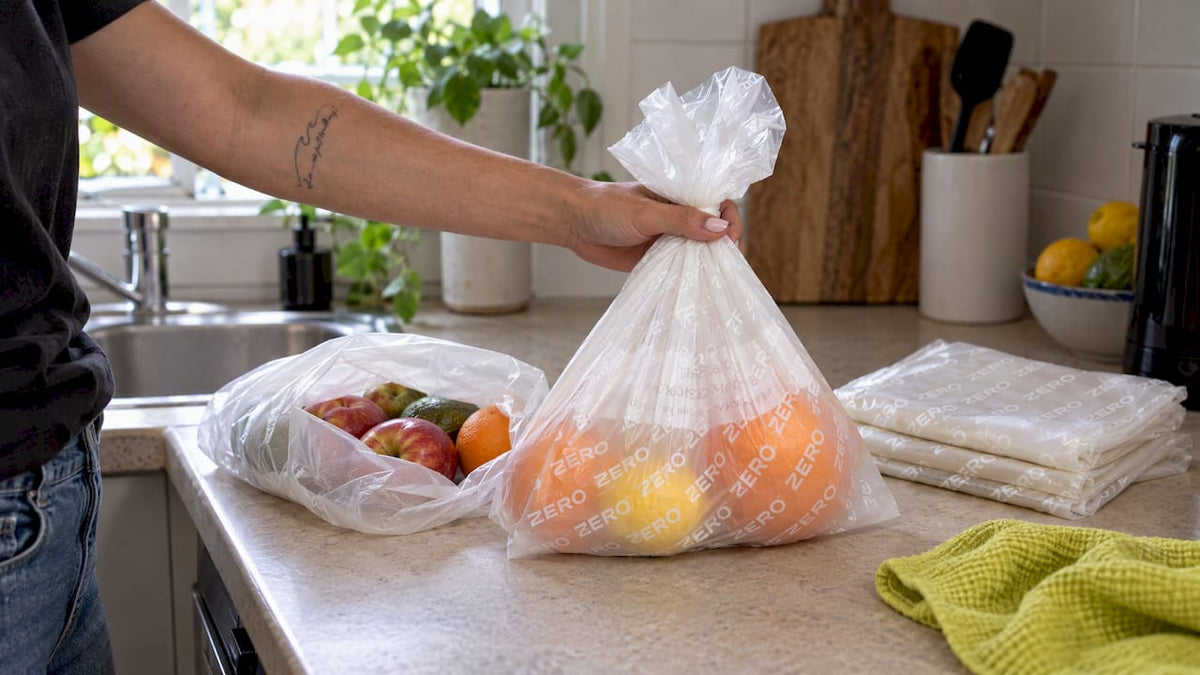
Most household compostable bags generally cost more per bag than conventional plastic, often several times the price, depending on size and certification. Certified home- or commercial-compostable bags with the Australasian Bioplastics Association (ABA) seedling or home logo sit at the upper end of that range. Buy certified only if your council or compost system requires it; buy in bulk only if you can store the bags properly.
TL;DR:
- Certified compostable bags typically cost between $0.08 and $0.30 per bag, depending on size, barrier properties, and certification level.
- The main factors increasing costs are the base polymer, certification fees, barrier layers, and processing for moisture resistance.
- Bulk purchases can reduce the per-bag cost but require proper storage conditions to prevent degradation before use.
- Non-certified biodegradable bags are often priced lower but lack independent verification and may not fully decompose in compost.
- Paying a premium makes sense for wet waste, nappy disposal, or when certification is required by your local council’s composting system.
Table of Contents
- Price breakdown: how to calculate per-bag and per-use costs
- What drives the price: materials, certification and barrier properties
- Comparing the cost per use against single-use plastic
- Where to buy and how to choose the right pack size
- Matching your needs to purchasable options
- The overall cost range, from budget to premium
- Total cost: bulk discounts, shipping and what you actually save
- How compostable bags compare with other eco-friendly options
- When paying the premium actually makes sense
- A simpler way to stock up on the essentials
- FAQ
- Sources
Price breakdown: how to calculate per-bag and per-use costs
Pack prices vary so much between brands that comparing the roll price alone is almost useless. The only number that matters is the price per bag, and from there, the price per use if you reuse anything before disposal.
The formula is simple: divide the pack price by the number of bags. For a roll of liners, divide the roll price by the number of bags on the roll.
- An 8 litre caddy liner roll of 55 bags priced at $5.60 works out to roughly $0.10 per bag, a council retail example worth using as a benchmark for kitchen caddy liners.
- A two-pack of produce bags priced at $79.95 covers a set of reusable mesh-style bags rather than single-use liners, so the comparison is per-use, not per-bag, since each bag is designed for repeated trips to the shop.
- Nappy waste bags typically come in packs of 25 to 50, and a pack priced around $14.95 reflects the cost associated with odour-barrier films these products need.
- Resealable food storage bags vary widely by size, with smaller snack-size bags costing less per unit than larger freezer-size bags from the same range.
Most buyers overpay by comparing pack price instead of unit price. A larger pack with a higher sticker price often has a lower cost per bag, but only if you will use every bag before it degrades in storage.
What drives the price: materials, certification and barrier properties
Three things push compostable bag prices above conventional plastic: the base polymer, the certification process and the barrier properties needed for wet or greasy waste.
Common compostable materials include PLA (derived from plant starches), PHA (produced by microbial fermentation) and PBAT (a flexible co-polyester often blended with PLA for stretch and strength). PHA tends to cost more to produce than PLA, and blends with PBAT add flexibility but also add cost compared with a single resin.
Certification adds a separate cost layer. The Australasian Bioplastics Association runs verification programmes against two different standards: AS 4736 for commercial composting and AS 5810 for home composting. Earning the right to display the seedling or home logo involves independent testing and a licence fee, both of which are reflected in shelf price.
- Printed branding and packaging add cost without changing performance.
- Moisture and grease barriers for food or nappy waste require additional processing steps.
- Smaller import runs and lower manufacturing scale raise the per-unit cost compared with mass-produced plastic film.
Pro tip: Check the pack for the ABA logo and licence number, and read the storage advice, before assuming a bag’s price reflects genuine commercial or home compostability.
Comparing the cost per use against single-use plastic
A standard plastic kitchen bin liner typically costs a few cents each. Against the $0.10 to $0.30 per-bag range for compostable equivalents, the premium is real and usually lands between two and five times the plastic price for an equivalent size.
That gap narrows in a few predictable situations rather than closing outright.
- Bulk purchases from council schemes or large multi-roll packs lower the per-bag price closer to premium plastic equivalents.
- Councils that supply subsidised compostable liners as part of a kerbside organics programme can bring the effective cost to the household down to near zero.
- Hidden costs change the real price per use: liners stored somewhere warm or humid can become brittle before you reach the bottom of the roll, and a bag that fails mid-use effectively doubles its cost.
- If no commercial composting facility accepts the bag locally, you’re paying a compostable premium for a bag that ends up in general waste anyway, which is worth checking before buying a large pack.
Local council guidance on compostable labelling notes that reusable packaging can be more economical over the long run than any single-use compostable item, even with a higher upfront cost.
Where to buy and how to choose the right pack size
Three channels cover most household purchases, and each has a different trade-off between price, convenience and certainty about what you’re buying.
Council customer service counters, as seen with the Onkaparinga example above, often sell subsidised rolls tied to a local organics programme, which usually means the cheapest genuinely certified option if you qualify. Supermarkets stock compostable liners and produce bags at a price premium but with no guarantee of certification unless you check the label yourself. Online specialists carry a wider range of sizes, barrier types and pack counts, useful when supermarket shelves only stock one size.
- Check the ABA seedling or home logo and the licence number before adding to cart.
- Confirm whether the bag is certified to AS 4736 (commercial) or AS 5810 (home), since your council’s green bin may only accept one.
- Read the storage and shelf-life notes, since compostable films degrade faster than plastic in heat or humidity.
- Match pack size to how quickly you’ll use the bags, not to the lowest per-unit price.
- Western Australia’s biodegradable barrier bag standard requires produce and barrier bags to carry no handles, meet translucency rules and show a minimum opening circumference, which affects which products qualify in that state.
- A smaller pack costs more per bag but avoids the waste of unused bags degrading in a cupboard.
Matching your needs to purchasable options
For readers ready to buy rather than keep comparing, three product types cover the most common household jobs. Plastic Free Produce Bags (2 Pack) suit grocery trips and loose fruit and vegetable storage. Plastic Free Resealable Food Storage Bags cover pantry, freezer and lunchbox use. Plastic Free Nappy Waste Bag packs handle odour-contained nursery waste. Catalogue listings, product specifications and FAQs on our site set out material composition and certification details for each line so you can check them against the standards covered above before buying.
The overall cost range, from budget to premium
Across the household compostable bag market, prices generally span three tiers. At the low end, basic compostable kitchen caddy liners without barrier coatings sit around $0.08 to $0.12 per bag, similar to the $0.10 per bag Onkaparinga council example above. The mid-tier, covering most supermarket and online-specialist liners with moisture resistance and clear certification labelling, runs from roughly $0.12 to $0.20 per bag.

Premium options, including scented nappy waste bags, heavier-gauge resealable storage bags and barrier-coated produce bags, can reach $0.25 to $0.30 per bag or more. The jump from budget to premium rarely reflects the base polymer alone. It more often reflects added barrier layers, printed branding, smaller manufacturing runs and the licensing cost tied to displaying a verified ABA logo.
Buying at the bottom of the range makes sense for dry waste with no odour or moisture concerns, where a basic certified liner performs the same job as a premium one. Paying for the premium tier makes more sense for wet kitchen waste, nappy disposal or any use where a bag failure creates mess or odour, since the cost of a failed cheap bag (replacement, cleaning, a messier job) can exceed the price difference several times over.
There’s no single “right” price point. The correct tier depends on what’s going in the bag, how long it sits before collection, and whether your council’s composting system even accepts the certification level you’re paying for.
Total cost: bulk discounts, shipping and what you actually save
Bulk packs usually lower the price per bag, but the saving only holds if every bag gets used while it’s still in good condition.
Shipping fees change the calculation for online orders. A cheap bulk pack with a flat shipping fee attached can cost more delivered than a mid-sized pack bought locally, especially for bulky items like rolls of produce bags. Always check the landed cost, meaning the pack price plus shipping, divided by the bag count, rather than the advertised unit price alone.
Storage conditions matter more for compostable materials than for plastic. Retailer product notes commonly recommend keeping compostable liners below 35°C and using them within a limited window after opening, since the same biodegradability that makes these bags break down in compost also makes them more sensitive to heat and humidity on the shelf. A bulk discount that leads to six months of bags sitting in a hot laundry cupboard isn’t really a discount.
The practical rule: buy in bulk only when you have a cool, dry storage spot and a household routine that will get through the pack within its stated shelf life. Otherwise, a smaller pack at a slightly higher per-bag price is usually the better total cost outcome.
How compostable bags compare with other eco-friendly options
“Biodegradable” and “compostable” aren’t interchangeable, and the price difference between them reflects that. A bag labelled biodegradable but not certified compostable has typically not been tested against AS 4736 or AS 5810, and may not break down fully or safely in either a home or commercial compost system. These bags often sell for less than certified compostable equivalents, sometimes close to conventional plastic pricing, precisely because they skip the certification and testing cost.
That lower price carries a trade-off. Guidance from Which Bin in South Australia points out that the ABA logo and certification number are the clearest way to confirm a bag is genuinely compostable rather than simply marketed as eco-friendly. Without that logo, a cheaper “biodegradable” bag may leave fragments behind in compost or simply break down into smaller plastic-like pieces rather than fully decomposing.
Oxo-degradable bags, which break down through chemical additives rather than microbial composting, sit in a similar lower-price, lower-certainty category. They’re generally cheaper than ABA-certified compostable bags but carry none of the same testing or acceptance guarantees at council compost facilities.
For readers managing a home compost bin as well as kerbside collection, pairing certified bags with good composting practice matters. Guidance on managing garden and food waste at home is a useful companion to understanding what conditions actually break these materials down, since a certified bag still needs the right compost environment to perform as labelled.

When paying the premium actually makes sense
I’d pay the premium for wet kitchen waste, nappy disposal or anywhere a bag failure means real mess, and for any bag your council’s compost scheme specifically requires. For dry rubbish or repeated shopping trips, a reusable cloth bag or washable container usually beats any compostable bag on both price and environmental impact over a year of use.
— Damien
A simpler way to stock up on the essentials
We offer certified, plastic-free options to simplify your choice, so you don’t have to cross-check logos and licence numbers on every pack before checkout. Plastic Free Produce Bags (2 Pack) handle the weekly shop, Plastic Free Resealable Food Storage Bags cover pantry and freezer storage, and Plastic Free Nappy Waste Bag packs manage nursery waste without the guesswork over certification.

Browse the full kitchen collection to compare sizes and pack counts, and check current pricing before you add a roll to your next order.
FAQ
How much do compostable bags cost?
Most household compostable bags cost between $0.08 and $0.25 per bag, depending on size, barrier properties and whether they carry ABA certification. An 8 litre council roll of 55 bags at $5.60 works out to roughly $0.10 per bag, as shown in the Onkaparinga council example.
Are compostable bags actually compostable?
Only bags carrying the ABA seedling or home logo and a licence number have been independently verified against AS 4736 (commercial) or AS 5810 (home), according to Which Bin. A bag marketed as “biodegradable” without that logo has not necessarily passed the same testing and may not fully break down in either compost environment.
How much are biodegradable bags?
Biodegradable bags without compostable certification are often priced close to or slightly above conventional plastic bags, since they skip the testing and licensing cost tied to ABA verification. They typically cost less than certified compostable equivalents, but come with less certainty about how completely they break down.
How much do compostable nursery bags cost?
Compostable nappy waste bags are priced to reflect the odour-barrier films these products need, such as a pack of Plastic Free Nappy Waste Bags at $14.95 per pack.
Where can I buy compostable bags?
Council customer service counters often sell subsidised rolls tied to local organics programmes, supermarkets stock a narrower range at a price premium, and online specialists carry the widest range of sizes and barrier types. Checking the ABA certification programme logo on the pack is the fastest way to confirm genuine compostability regardless of where you buy.
Share:
4 months to compost: AS 4736/5810 and compostable packaging myths in Australia