
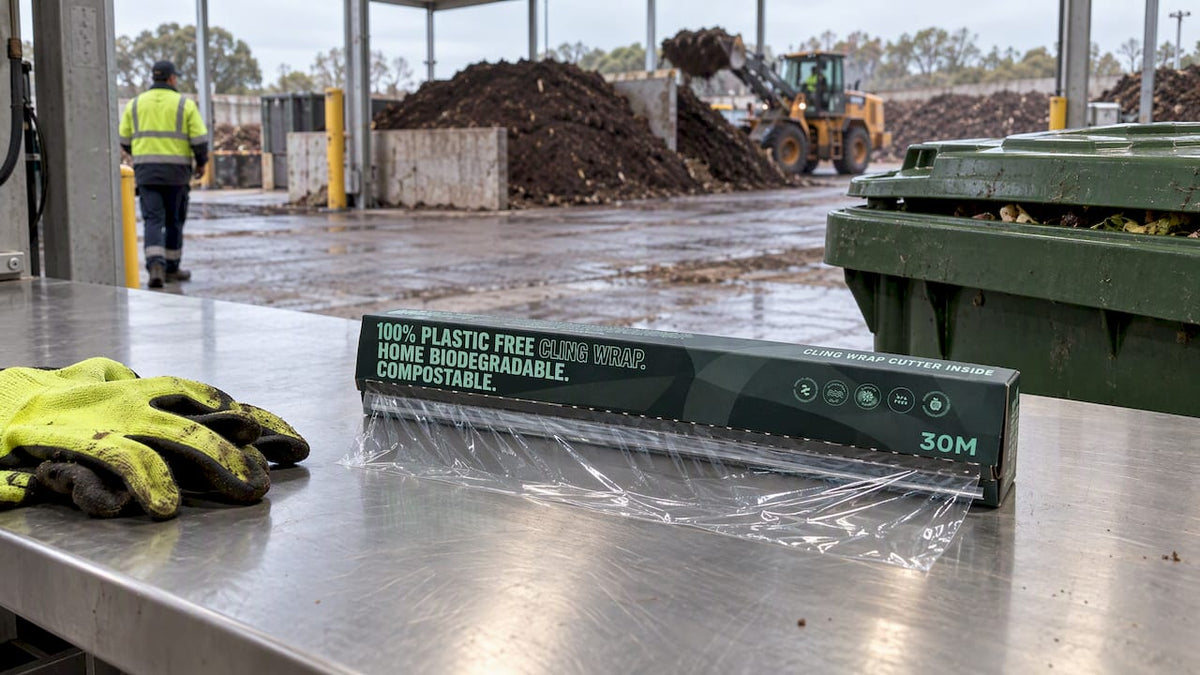
Not every claim about compostable packaging holds up. Whether a product breaks down as promised depends almost entirely on two things: which certification it carries and whether your local council or processor actually accepts that certification. A bag marked “compostable” with no AS 4736 or AS 5810 number and no Australasian Bioplastics Association listing is a guess, not a guarantee.
TL;DR:
- Certification numbers from AS 4736 or AS 5810, verified through the Australasian Bioplastics Association, are essential to confirm genuine compostability claims.
- Industrial composting conditions are necessary for certified items to reach around 98% mass loss within four months, making placement in the wrong environment ineffective.
- Most councils only accept AS 4736 items for industrial composting, while AS 5810 is suitable for home composting, but acceptance varies based on local facility capabilities.
- Contamination from lookalike plastics and PFAS in packaging poses significant challenges, often leading to rejection of entire loads from composting facilities.
- Reusable containers and properly certified compostable packaging suited to local disposal infrastructure are the safest options for reducing environmental impact.
Table of Contents
- Seven myths about compostable packaging that refuse to die
- What the science says about compostable performance
- How Australian standards and labelling rules separate fact from marketing
- Why your council’s FOGO rules decide the real outcome
- Why PFAS and lookalike plastics threaten the whole organics stream
- A simple framework for choosing compostable packaging
- Our take on the compostable packaging debate
- Practical swaps that avoid the guesswork
- FAQ
- Sources
Seven myths about compostable packaging that refuse to die
Misunderstandings about compostable materials are common, and most come from treating “compostable” as a single, simple promise rather than a technical claim with conditions attached.
- Myth: it composts anywhere, including landfill or the ocean. Compostable items need oxygen, moisture, heat and microbial activity. Landfill is largely anaerobic and often produces methane instead of breaking the material down; the ocean has none of the required conditions at all.
- Myth: “biodegradable” and “compostable” mean the same thing. Biodegradable only means something will eventually break down, with no timeframe or standard attached. Compostable means it has been tested against a recognised standard, such as AS 4736 or AS 5810, and breaks down within a defined period into non-toxic, usable compost.
- Myth: home compost bins can process anything labelled compostable. Items certified to AS 4736 are designed for the sustained high heat of industrial facilities, not a backyard bin. Only AS 5810-certified products are built to break down at the lower, less consistent temperatures of home composting, as council guidance from the City of Greater Geelong explains.
- Myth: compostable packaging always has a smaller environmental footprint. Production of bio-based resins can carry a higher carbon cost than conventional plastic. The benefit only materialises at end of life, and only if the item actually reaches a composting facility.
- Myth: a compostable label guarantees your council will accept it. Acceptance depends on each facility’s contracts and processing capability, not just the packaging’s certification.
- Myth: compostable packaging cannot perform like plastic. Modern PBAT and PLA blends can hold moisture, resist tearing and stretch similarly to polyethylene film when formulated correctly.
A 2025 life cycle assessment found that industrially composted PBAT-blend packaging delivers net carbon savings of 11.35 kg CO2-eq per kg compared with sending polyethylene to landfill, which is a meaningful advantage, but one that only applies when the composting route actually exists (MDPI, 2025).
What the science says about compostable performance
The strongest case for compostable packaging comes from life cycle assessment data, not marketing copy, and the numbers come with conditions attached.
A 2025 LCA of PBAT-blend packaging calculated production emissions of 8.64 kg CO2-eq per kg, which sounds like a disadvantage against conventional polyethylene. But when the same material is sent to industrial composting rather than landfill, the comparison flips: net savings of 11.35 kg CO2-eq per kg against landfilled polyethylene, driven almost entirely by what happens at end of life rather than during manufacturing (MDPI, 2025).
The degradation data backs this up at the material level rather than just on paper.
- Certified compostable material in the same study reached roughly 98% mass loss within four months under industrial composting conditions.
- That breakdown rate depends on sustained temperatures, moisture and microbial activity that only commercial facilities reliably maintain.
- Production emissions for bio-based resins can exceed those of conventional plastic, meaning the environmental case rests entirely on the material reaching a composting facility rather than landfill.
Certified compostable PBAT blends can reach around 98% mass loss within four months under industrial composting, a result that depends entirely on consistent access to an industrial facility (MDPI, 2025).
The trade-off is straightforward: higher upfront production impact, offset by genuine end-of-life savings, but only where the infrastructure exists to realise them. Without a composting pathway, the upfront cost stands with no offsetting benefit, which is why the next question, how to recognise genuine certification, matters just as much as the chemistry.
How Australian standards and labelling rules separate fact from marketing
Two standards do almost all the work in this space. AS 4736 covers industrially compostable packaging, tested for breakdown in the high, sustained heat of a commercial facility. AS 5810 covers home compostable packaging, tested against the lower, more variable conditions of a backyard bin. Putting an AS 4736 item in home compost, or assuming a home-compostable item will survive general landfill, misreads what each standard actually certifies.
Verification runs through the Australasian Bioplastics Association, which issues an ABA number once a product has passed independent laboratory testing, often carried out by DIN CERTCO, against the relevant standard. That ABA number, printed on the pack, is the one piece of evidence worth checking before you trust a compostability claim (WA government guidance).
Labelling rules have tightened recently. From 1 September 2024, AS-certified compostable bags and shopping bags needed clear labelling to qualify for exemptions under state prohibited-plastics rules, and from 1 March 2026 the same clarity is required for individual food and beverage containers (SA government guideline).
Before you buy or bin an item, work through this:
- Look for an AS 4736 or AS 5810 number on the pack, not just the word “compostable”.
- Check for an ABA certification number and confirm it against the Australasian Bioplastics Association listing.
- Note which standard applies: AS 4736 means industrial only, AS 5810 means home composting is possible.
- Confirm your council or kerbside service accepts that specific category before binning it.
Why your council’s FOGO rules decide the real outcome
Certification tells you what a product is capable of. Your council’s FOGO or FOGO-equivalent programme tells you what actually happens to it, and the two frequently disagree.
Facilities differ in temperature control, processing time and contract terms with waste haulers, so an AS 4736-certified item accepted in one council area can be explicitly excluded in another. Some councils have restricted or removed compostable packaging from kerbside organics altogether after finding it slowed processing or confused residents about what belongs in the bin, a pattern documented in council-based waste education research (Cambridge Core, 2026).
Before you rely on a product’s compostable claim, run through this:
- Check your council’s website for its current accepted-items list for organics or FOGO bins.
- Call the council or processor directly if the list does not mention compostable packaging specifically.
- Never assume AS 4736 certification equals kerbside acceptance; it only means the item is industrially compostable somewhere.
- Keep genuinely non-compostable plastic out of organics bins regardless of how a product is marketed.
Pro Tip: To test an AS 5810 home-compostable item, bury a small, cut-up piece in an active compost pile and check it every few weeks; if it has not visibly broken down within the timeframe the label promises, your bin may not be reaching the temperatures needed.
Why PFAS and lookalike plastics threaten the whole organics stream
Contamination, not the compostable material itself, is the biggest operational headache for organics processing. Soft plastics that look like compostable film are routinely mistaken for the real thing, and once they are mixed into a load, separating them becomes a manual, labour-intensive job.
PFAS adds a separate layer of concern. Regulatory consultation work notes that PFAS in packaging and food-contact materials is more often linked to recycled paper fibres and specific grease-resistant coatings than to certified compostable bioplastics themselves, though agencies continue investigating sources across the supply chain (Australian government PFAS consultation).
Processors respond with screening equipment and manual picking, but when contamination is bad enough, entire truckloads can be rejected and sent to landfill instead of composting, a finding consistent with council and academic reviews of kerbside contamination (Cambridge Core, 2026).

Policy tools that help include clear labelling requirements, extended producer responsibility schemes and contractual conditions between councils and processors that specify exactly what will and will not be accepted.
What you can do:
- Read the certification number before assuming a bag or wrap is genuinely compostable.
- Ask vendors directly which standard their packaging is certified to, not just whether it is “eco-friendly”.
- Choose products with a visible ABA number over generic “green” claims.
- Keep plastic film, even if it looks similar, out of organics bins unless you have confirmed certification.
A simple framework for choosing compostable packaging
Four questions settle most decisions: what is the item for, do you have genuine disposal access, could it be reused instead, and how likely is it to contaminate a stream if you get it wrong.
- Function first: reusable options beat single-use almost every time, compostable included.
- Disposal access: only choose AS 4736 items if your council accepts them, or AS 5810 items if you compost at home.
- Reuse potential: a resealable bag you wash and reuse several times beats any single-use alternative, compostable or not.
- Contamination risk: skip compostable packaging entirely if you cannot distinguish it from lookalike plastic at disposal time.
A council curbside collection with confirmed AS 4736 acceptance makes compostable food packaging a sound choice; no organics service at all makes a reusable container the safer one.
Our take on the compostable packaging debate

The loudest argument against compostable packaging, that it is all “greenwashing” because councils cannot process it consistently, misses the actual problem. The materials science is solid: certified PBAT and PLA blends genuinely break down under the right conditions, and the carbon savings are real when the infrastructure exists. The gap is not the packaging. It is that labelling, council contracts and public education have not caught up with the certification system.
That means the burden currently sits on the consumer to check a number on a pack before trusting a claim, which is a poor substitute for consistent national rules. Until labelling requirements and FOGO programmes align everywhere, the honest advice is to treat compostable certification as a conditional promise rather than an automatic win, and to keep reusable options as the default wherever they are realistic.
— Damien
Practical swaps that avoid the guesswork
We build our own range around the principle of using materials with genuine certification. Our Plastic-Free Cling Wrap, Plastic Free Resealable Food Storage Bags and Plastic Free Produce Bags (2 Pack) are made from bio-polymers including PLA, PHA and PBAT, free from microplastics and the harmful chemicals found in some conventional films.

- Our Plastic Free Produce Bags (2 Pack) suit loose fruit and vegetables where you want breathability without single-use plastic.
- Our Plastic Free Resealable Food Storage Bags work for snacks, leftovers and freezer storage where you would otherwise reach for a zip-lock bag.
- Our Plastic-Free Cling Wrap replaces standard cling film for covering bowls and wrapping food, without the plastic residue.
We are upfront about material sourcing and certification on every product page rather than leaving shoppers to guess. If you want to check what your current cling film or food bags are actually made from, our kitchen range is a straightforward place to compare.
FAQ
What are the disadvantages of compostable packaging?
Compostable packaging only breaks down properly under the right conditions, so items can sit unchanged in landfill or a home bin that never reaches the right temperature. Production of bio-based resins can also carry higher emissions than conventional plastic, meaning the environmental benefit depends entirely on the item reaching a suitable composting facility (MDPI, 2025).
What are five items that should not be composted?
Conventional plastic bags, items marked “biodegradable” with no AS 4736 or AS 5810 certification, synthetic fabric, treated or painted wood, and anything containing metal or foil should stay out of compost and organics bins. These items either fail to break down or contaminate the load, forcing processors to reject the batch (council and academic research).
Do compostable bags actually compost?
Yes, when they are genuinely certified and sent to the composting environment that standard requires. AS 4736-certified bags need an industrial facility, while AS 5810-certified bags are tested for home compost conditions, and certified PBAT blends can reach around 98% mass loss within four months industrially (MDPI, 2025).
Why are compostable bags not allowed in some council bins?
Some councils restrict compostable bags because their processing facilities cannot reliably distinguish them from lookalike plastic film, or because the bags slow down sorting equipment designed for garden and food organics only. Checking your council’s current accepted-items list is the only reliable way to know before you bin one (Geelong council guidance).
Sources
- Life Cycle Assessment Sheds New Insights Toward Sustainable Management of Biodegradable Resin Blends Used in Packaging: A Case Study on PBAT
- Guide to labelling requirements for certified compostable items
- Compostable labelling | City of Greater Geelong
- Guidance on biodegradability certification bodies (WA government)
- It’s Written on the Bin! A Snapshot Evaluation of Kerbside Bin Contamination from the Perspectives of Council-Based Waste Educators
Share:
Evidence shows compostable wrap keeps food fresher in Australia
Stop Overpaying: Compostable Bags in Australia, $0.08–$0.25 Per Bag