
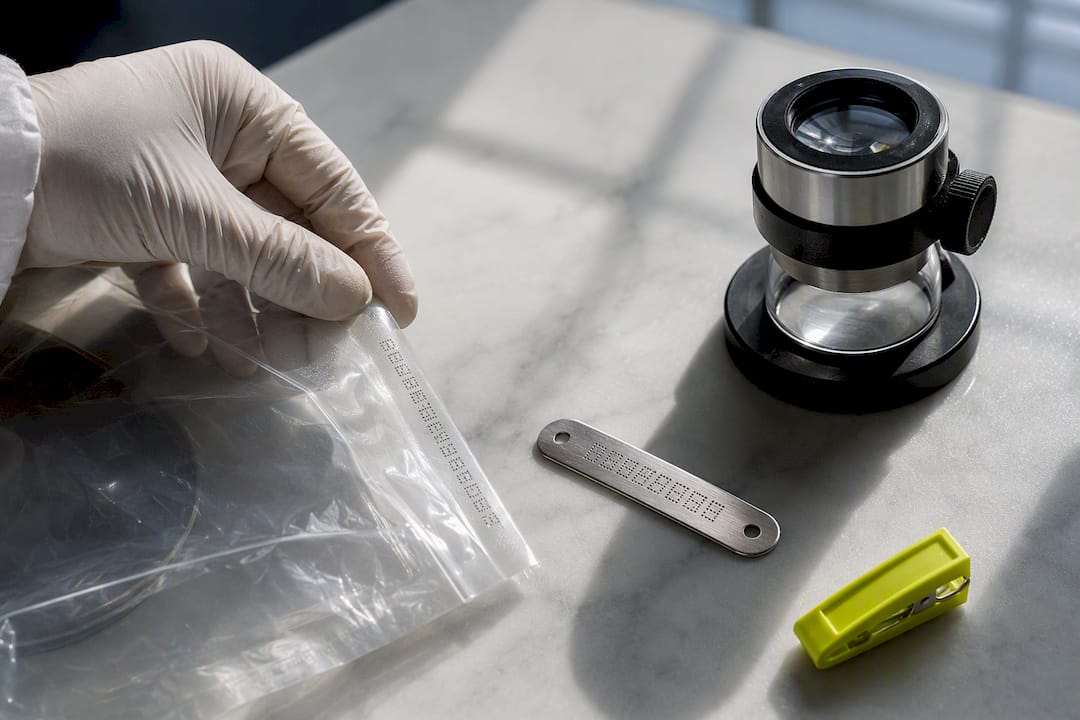
EN 13432 is the European standard that certifies finished packaging as industrially compostable. It’s a pass or fail laboratory test, not a marketing term, covering biodegradation, disintegration, chemical safety and ecotoxicity. Passing it means a product will break down in an industrial composting facility within a set timeframe. It says nothing about home composting, landfill, or the ocean.
TL;DR:
- EN 13432 verifies that finished packaging biodegrades and disintegrates in industrial composting within a set timeframe, but does not apply to home composting or landfills.
- Certification depends on four tests: biodegradation, disintegration, chemical safety, and heavy metal limits, with a focus on the entire finished product, not just the raw material.
- Certificates are time-limited and valid only if specific SKU details, thickness, inks, and adhesives are within tested scope; logos alone are insufficient proof.
- Relying solely on logos or claims without verifying the actual certificate, trace code, and expiration status exposes brands to greenwashing and regulatory risks.
- Cross-market claims should specify certification standards and scope, as EN 13432 is for industrial composting, unlike standards like OK compost HOME for home compostability.
Table of Contents
- What EN 13432 covers: scope, purpose and typical materials
- What are the four EN 13432 test pillars?
- How does EN 13432 certification actually work?
- Who actually needs EN 13432 evidence?
- How does EN 13432 compare to ASTM, ISO and home-compost standards?
- What are the biggest EN 13432 mistakes and greenwashing risks?
- How The Zero Store handles compostability documentation
- Why verification matters more than the logo
- Shop plastic-free alternatives backed by real documentation
- Sources
What EN 13432 covers: scope, purpose and typical materials
EN 13432 is a European Committee for Standardization (CEN) standard, formally titled “Packaging — Requirements for packaging recoverable through composting and biodegradation”. It exists to give composters, regulators and buyers one consistent test for whether packaging can go into industrial composting streams instead of landfill or incineration, tying directly into EU packaging waste policy.
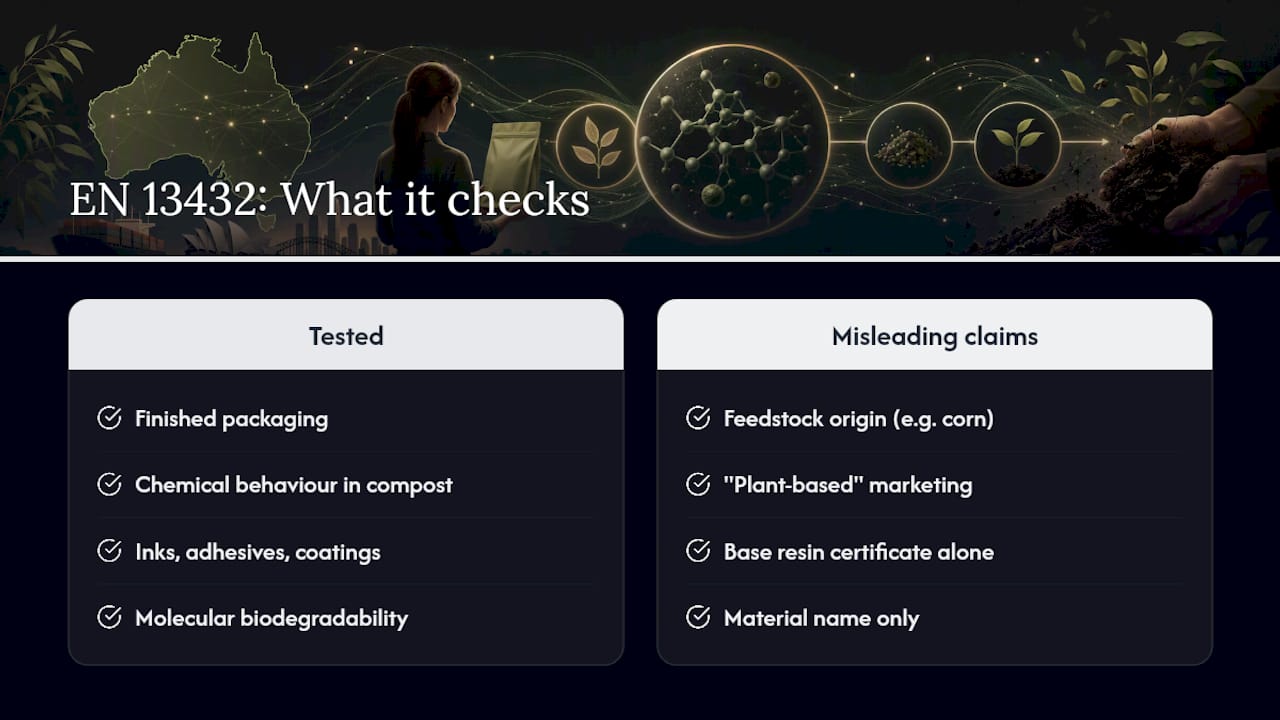
The standard doesn’t care what a material is made from. It cares what happens to it chemically once it’s in a compost pile. That’s why materials as different as PLA (a corn or sugarcane derived plastic), PBAT blends, bagasse fibre, and cellulose films can all pass, while some products marketed as “plant-based” or “natural” fail outright. Biodegradability is a function of molecular structure, not feedstock origin. A wood pulp product with the wrong coating can behave worse in compost than a lab engineered polymer built to break down cleanly.
Crucially, EN 13432 tests the finished product, not just the raw resin. Inks, adhesives, laminates and coatings are all inside the test boundary. A supplier can hold a certificate for their base film and still sell a bag that fails EN 13432 once you add a printed logo or a heat-seal adhesive that doesn’t break down at the same rate. This single point trips up more buyers than any other part of the standard, and it’s worth committing to memory before you take any certificate at face value.
What are the four EN 13432 test pillars?
Every EN 13432 certificate rests on four separate laboratory tests, and a product has to clear all four. Understanding the thresholds is the difference between reading a certificate and actually understanding what it guarantees.
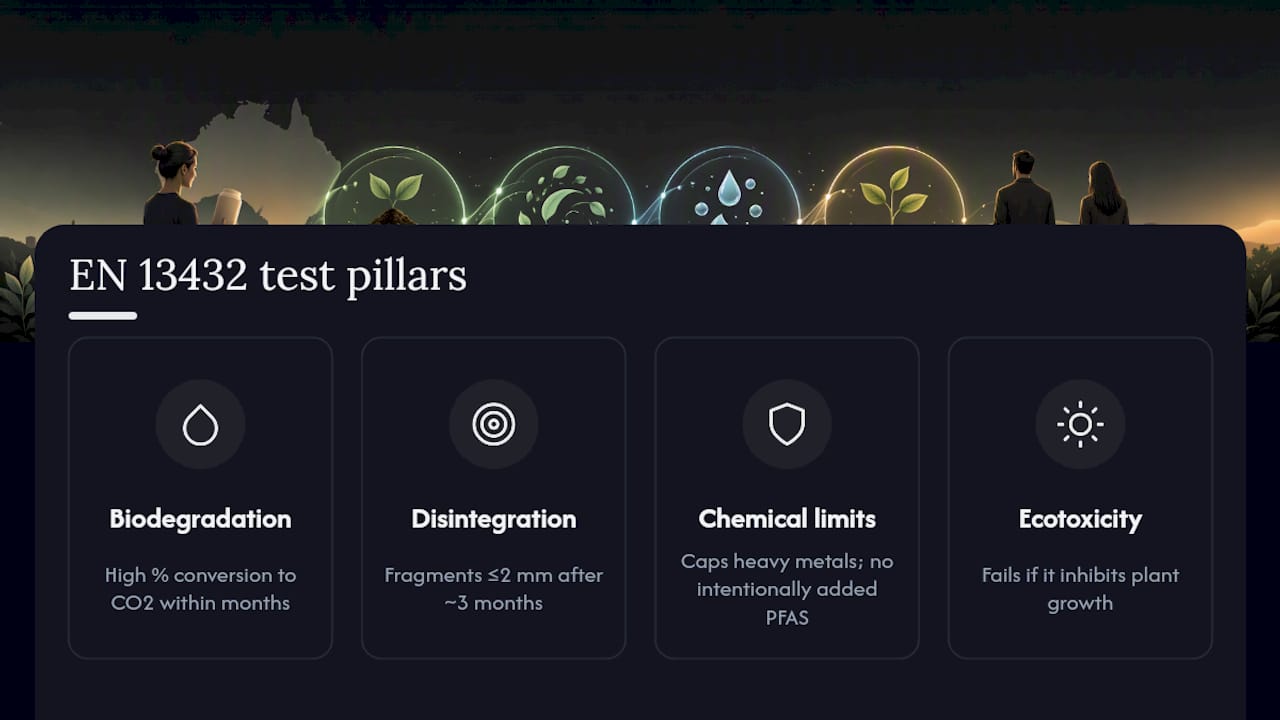
Biodegradation measures how much of the material converts to carbon dioxide, water and biomass under controlled composting conditions. The threshold is at least a high percentage of conversion to CO2 within several months, tested using respirometry, where microorganisms in a controlled compost environment consume the material and the CO2 they produce is measured against a reference material.
Disintegration is a separate physical test. It asks whether the material falls apart into small enough fragments during real composting conditions, run as a pilot-scale test alongside organic waste. The limit is a small portion of the original mass remaining as fragments larger than 2mm after about three months. This is why a product can technically biodegrade chemically but still fail if it leaves visible plastic-like shards behind.
Chemical and heavy-metal limits cap concentrations of substances like lead, cadmium, mercury and chromium, and the standard prohibits intentionally added PFAS. This exists because the whole point of industrial composting is producing usable soil amendment. A material that “disappears” but leaves toxic residue behind hasn’t solved anything.
If plants struggle to grow in soil containing the composted material, it fails, regardless of how well it degraded chemically.
One detail buyers routinely miss: certificates carry thickness and format limits. A film certified at 20 microns doesn’t automatically cover a thicker version of the same resin, because thickness changes disintegration behaviour. Always check the SKU-level specification, not just the material name.
How does EN 13432 certification actually work?
Certification follows a fairly linear sequence. A manufacturer discloses the full formulation, including inks and adhesives, to an accredited laboratory. The lab then runs the four pillar tests against the finished product, not a theoretical version of it. Once results come back, a certification body audits the documentation before issuing a certificate with a unique trace code.
The lab work alone typically takes months, because biodegradation testing has to run for its full assessment window to produce valid data. Realistically, brands should budget three to twelve months for the complete process from formulation lock to certificate in hand, longer if reformulation is needed after a failed test.
The names to look for on a genuine certificate are TÜV Austria, which issues the OK compost INDUSTRIAL mark, and DIN CERTCO, which issues comparable marks under EN 13432 conformity. The Seedling logo, licensed through European Bioplastics, is another recognised industrial-compostable mark tied to the same underlying standard.
Here’s the part that catches people out: these logos are licensed, scoped and time-limited. DIN CERTCO and equivalent certifiers control certificate validity, and a certificate can lapse or become void if the manufacturer changes the formulation, the ink, or the maximum thickness without retesting. Seeing a logo printed on packaging tells you almost nothing on its own. The certificate behind it, with its trace code and expiry date, is what actually matters.
Who actually needs EN 13432 evidence?
Not every seller of a compostable product needs a certificate pinned to the wall, but the practical stakes differ sharply depending on who you are.
- Exporters and brands selling into EU markets under a compostable claim are expected to hold EN 13432 evidence, since regulators and retail buyers increasingly ask for it as standard due diligence.
- Retailers and composting facility operators use EN 13432 certification as an acceptance signal, deciding whether a batch of packaging is safe to run through their organic waste stream without contaminating the finished compost.
- Smaller or local sellers may face less direct enforcement, but the underlying verification principles, checking the certificate and trace code rather than trusting a label, still apply if you want the claim to hold up.
- Buyers and procurement teams carry reputational risk if they repeat an unverified compostability claim that later turns out to be resin-only or expired.
The common thread is greenwashing exposure. A compostable claim without paperwork behind it is a liability the moment someone asks a question you can’t answer.
How does EN 13432 compare to ASTM, ISO and home-compost standards?
EN 13432 isn’t the only compostability standard in circulation, and confusing it with its cousins causes real problems. ASTM D6400 is the equivalent standard for the US and Canadian markets, testing broadly similar biodegradation and disintegration criteria, but it’s a separate certification issued under a different regional scheme. A product certified under one doesn’t automatically carry the other; brands selling into multiple markets often hold both.
ISO 17088 and EN 14995 cover closely related scopes and are sometimes referenced alongside EN 13432 on technical datasheets, largely because European standards bodies built them to align.
The distinction that matters most for everyday buyers is industrial versus home composting. EN 13432 says nothing about whether a product will break down in a backyard compost bin, which runs cooler and slower than an industrial facility. That’s a separate certification, OK compost HOME being one recognised scheme, alongside France’s NF T51-800, and the test regimes are genuinely different. Our guide on compostable versus biodegradable claims covers this distinction in more depth. The safe move for any cross-market claim is asking which certifier and which scope applies to each market you sell into.
What are the biggest EN 13432 mistakes and greenwashing risks?
The most common failure is assuming a resin supplier’s certificate covers the finished product. It doesn’t. Add a print, a laminate or an adhesive that wasn’t in the original test, and the certificate no longer applies to what’s actually on the shelf.
The second is language slippage: labelling something “home compostable” when it only holds EN 13432 industrial certification, or calling something “biodegradable” as though that were interchangeable with a tested compostability claim. It isn’t, and that distinction has tripped up plenty of well-meaning brands.
Watch for these red flags on any supplier claim:
- No trace code visible on the certificate. A genuine EN 13432 certificate always carries a unique reference number tied to the certifier’s registry.
- No SKU or thickness limit stated. If the paperwork doesn’t specify exactly which product and format it covers, it’s not proof for the item in front of you.
- Logo present, certificate absent. Ask for the actual document, not just permission to use the mark.
- Expired or unchecked dates. Certificates lapse; cross-check the expiry against the certifier’s public database.
- Inks and adhesives unmentioned. If the finished product includes printing or bonding, confirm those materials are explicitly within the tested scope.
Pro Tip: Always ask suppliers to confirm, in writing, that inks and adhesives were included in the certified test, not just the base film. It’s the single question that exposes the most resin-only certificates.
How The Zero Store handles compostability documentation
The Zero Store’s product pages for ranges like resealable bags list material composition, certification status and finished-product scope rather than relying on a logo alone. Materials such as PLA and PBAT behave differently under industrial composting, and that’s reflected in how each product’s specifications are presented.
When sourcing new lines, the standard due diligence request includes the certifier name, trace code, SKU and thickness limits, and confirmation that inks and adhesives sit within the tested scope, the same checklist any procurement officer should be running. That documentation is available on request for buyers who want to verify a claim rather than take it on trust.
Why verification matters more than the logo
The conventional advice on compostable packaging stops at “look for the Seedling logo” or “check for OK compost INDUSTRIAL”. That’s a start, not an answer. A logo tells you a certification scheme exists somewhere in the product’s history. It doesn’t tell you whether the specific item in your hand, at its actual thickness, with its actual print, still matches that certificate.
What the evidence actually supports is a shift in habit: treat the trace code as the real credential, and the logo as decoration. Cross-checking against a certifier’s registry takes minutes. Skipping that step is how resin-only certificates end up printed on finished bags that were never independently tested. Composting facilities reject contaminated loads for exactly this reason, and it’s usually traceable back to someone trusting a logo instead of reading the paperwork behind it.
If you buy or sell compostable packaging professionally, the certificate and its scope should matter more to you than the artwork on the pack. Ask for the document. Check the date. Confirm the SKU. That’s the whole job, and most people still skip it.
— Damien
Shop plastic-free alternatives backed by real documentation
Compostability claims are only as good as the paperwork behind them, and some companies build their ranges around products they can actually document, not just label. If you’re replacing everyday plastics at home, the plastic-free cling wrap and resealable food storage bags cover the two items most households reach for daily.
Beyond food storage, the range extends to produce bags, cleaning wipes, reusable cleaning cloths, baby wipes, makeup wipes, and nappy waste bags, all built from bio-polymers like PLA and PBAT with certification details available on request. Whatever you’re switching out, the same rule from this article applies: ask for the certificate and trace code before you trust the claim, whether it’s ours or anyone else’s. Browse the full plastic-free range to see specifications for each product before you buy.
Sources
- EN 13432 certified bioplastics performance in industrial composting – European Bioplastics e.V.
- OK compost INDUSTRIAL - OK Certification
- EN 13432 Compostability Standard: Buyer’s Guide | Ecofy
- DIN CERTCO – certification of industrially compostable products
Share:
Pregnancy Safe Wipes: 5 Ingredients to Avoid and the Unscented Trap
Start With One Swap: Plastic Free Lunchbox Ideas for Australians