

Bioplastics can cut some environmental harms, particularly carbon emissions, but they routinely trade one problem for another. Whether a bioplastic genuinely beats conventional plastic depends on the polymer, the feedstock behind it, and whether it actually reaches the right composting stream at the end of its life. Buy the wrong one and dispose of it badly, and you can end up worse off than if you’d stuck with polyethylene.
TL;DR:
- Bio-based plastics often reduce greenhouse gas emissions but can significantly increase land and water use if made from first-generation crops grown solely for plastic production.
- Bioplastics like PHAs and thermoplastic starch are reliably biodegradable in natural environments, while PLA requires industrial composting conditions to break down effectively.
- Misleading labels and lack of accessible composting infrastructure mean many certified compostable bioplastics end up in landfills or water environments, posing microplastic and micro-organism risks.
- Reusable alternatives generally outperform single-use bioplastics, especially where recycling or proper composting options are unavailable or limited locally.
- Better system development, clear labeling, and reducing overall plastic demand are more effective than material substitution alone in tackling environmental impacts.
Table of Contents
- Bioplastic vs plastic: what the terms actually mean
- Do bioplastics actually reduce environmental harm?
- How and where do bioplastics actually break down?
- What actually happens to bioplastics after you bin them?
- How do you check a bioplastic claim before you buy?
- Bioplastic or reusable: which actually solves your problem?
- What transparent bioplastic labelling should look like
- Why scepticism and better systems matter more than material swaps
- Practical swaps if you’re acting on this today
- Sources
- FAQ
Bioplastic vs plastic: what the terms actually mean
Most confusion around bioplastic vs plastic comes from three words being used as if they’re interchangeable: bio-based, biodegradable, and compostable. They’re not the same thing, and mixing them up is how greenwashing survives.
- Bio-based means the plastic is made wholly or partly from renewable biomass, such as corn starch or sugarcane. It says nothing about whether the material breaks down. Bio-PET and bio-PE are classic examples: chemically identical to their fossil twins, just grown rather than drilled.
- Biodegradable means microorganisms can break the material down, but the word carries no timeframe or environment. Something can be “biodegradable” over three years in soil, three months in a compost facility, or theoretically never in a cold ocean.
- Compostable is the tightest term. It means the material breaks down within a defined period, under defined conditions, without leaving toxic residue, typically verified against an industrial composting standard.
The common polymers fall into two rough camps. PLA (polylactic acid), PHAs (polyhydroxyalkanoates), PBAT, PBS, and starch blends are purpose-built to biodegrade or compost. Bio-PET and bio-PE are “drop-in” bioplastics: bio-based but behaving exactly like conventional plastic, including in landfill, where they persist for years. Reviews warn against treating all bioplastics as uniformly environmentally friendly, because biodegradability and toxicity vary enormously by polymer type and test method.
Do bioplastics actually reduce environmental harm?
Life-cycle assessments tell a more complicated story than “plant-based equals greener.” Bio-based plastics can lower greenhouse gas emissions across their production cycle, largely because growing feedstock absorbs carbon that fossil extraction never gives back. That’s the genuine upside, and it’s real.
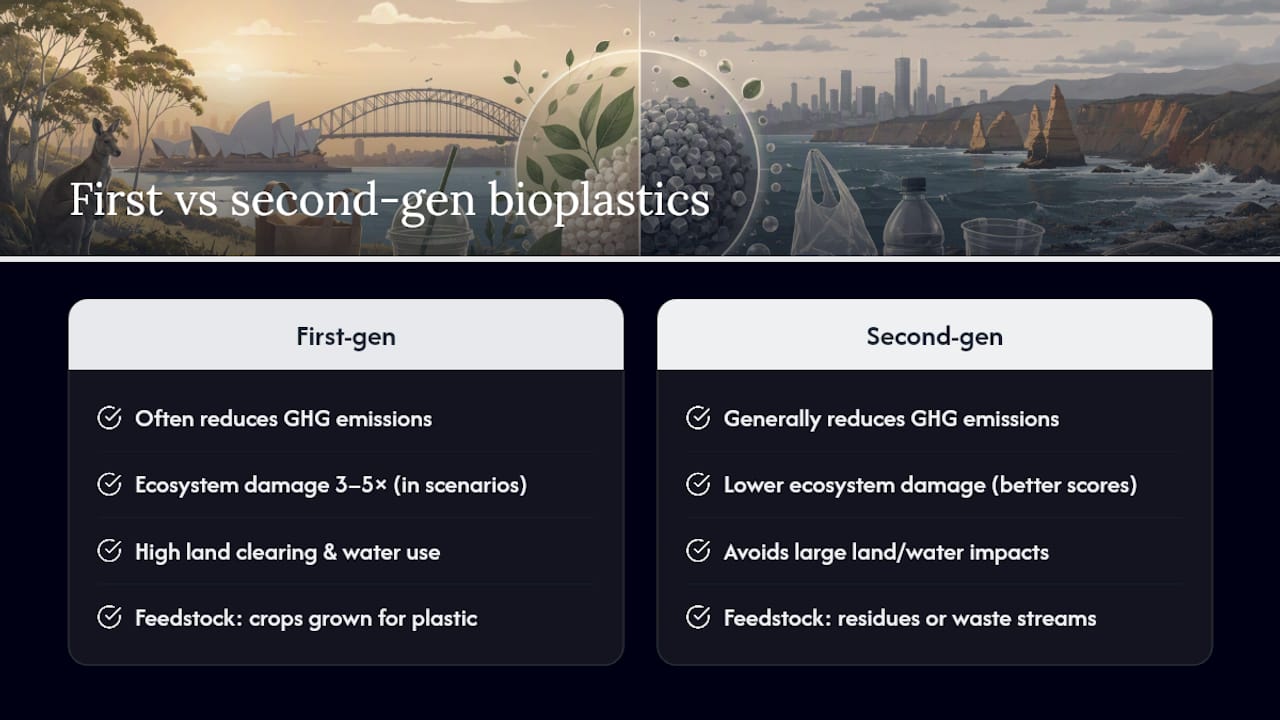
The trade-off shows up in land and water. A 2023 review from the University of Technology Sydney found that swapping fossil plastics for first-generation bio-based alternatives, meaning crops grown specifically for plastic feedstock rather than crop waste, can raise cumulative ecosystem damage three to fivefold in some scenarios, driven by land clearing and water use.
A harmonised life-cycle assessment published in Nature Communications reached a similar conclusion from a different angle: bio-based packaging typically reduces emissions but increases ecosystem damage primarily through land occupation and land-use change, with the same three-to-fivefold jump in ecosystem damage appearing under substitution scenarios running to 2050.
Statistic callout: Substituting first-generation bio-based plastics for fossil ones could increase cumulative ecosystem damage by three to five times under some modelled scenarios, even as greenhouse gas emissions fall.
Why the split result? Allocation. First-generation biomass, crops grown purely for plastic, competes with food production and forest land. Second-generation feedstock, made from agricultural residue or waste streams, avoids much of that competition and generally scores better across both carbon and biodiversity measures. The Nature Communications analysis stresses that LCAs need to explicitly model land-use change and realistic disposal pathways, otherwise they can flatter bio-based materials on climate while hiding the ecosystem cost.
How and where do bioplastics actually break down?
Not every bioplastic behaves the same way once it leaves your kitchen, and this is where a lot of consumer confusion sits.
- PHAs and thermoplastic starch are among the more reliably biodegradable materials, breaking down across a genuine range of natural environments including soil and fresh water, according to a comprehensive biodegradability review.
- PLA typically needs sustained industrial composting temperatures (around 55 to 60°C) to break down within a realistic window. Left in a backyard compost bin or the ocean, it can persist for a very long time.
- PBAT and PBS sit somewhere in between, generally certified for industrial composting rather than home composting or marine environments.
There’s a second, less publicised risk: ageing. Some bioplastics, PLA included, can fragment into microplastics and release dissolved organic carbon as they age, particularly outside controlled composting conditions, according to the UTS review. That’s a material breaking down partially rather than fully mineralising, which is the opposite of what “biodegradable” implies to most shoppers.
Pro Tip: If a product says “compostable” but doesn’t specify industrial or home composting, assume industrial. Tossing it in a backyard bin usually just means slower, incomplete breakdown rather than a genuine solve.
For a deeper look at how ageing affects one specific polymer, see this breakdown of PLA and microplastic formation.
What actually happens to bioplastics after you bin them?
Good intentions collide with bad infrastructure more often than manufacturers admit. A material’s lab-tested compostability means little if the bin it lands in never reaches a facility built to process it.
- Contamination risk. Compostable items thrown into kerbside recycling can contaminate a whole batch, forcing sorters to divert loads to landfill. Compostable items thrown into general waste sit in landfill, where anaerobic conditions can generate methane rather than the clean breakdown composting promises.
- Access gaps. Industrial composting facilities that accept certified compostable packaging aren’t universal, and acceptance rules vary between councils. The UTS full report found many compostable products in Australia end up in landfill simply because no local stream accepts them.
- Littering behaviour. Perhaps the most counterintuitive finding: labelling something “biodegradable” can make people more likely to litter it, on the assumption it will vanish harmlessly. Survey evidence from the same UTS report shows this belief is widespread and largely unfounded outside proper composting conditions.
Even certified compostable material can sit for years if it lands somewhere other than the facility it was designed for. Certification guarantees performance under specific conditions, not everywhere.
How do you check a bioplastic claim before you buy?
Labelling on plastic-free products ranges from rigorous to meaningless, and the gap is hard to spot without knowing what to look for.
- Look for a named industrial composting standard, not just the word “compostable” on its own. A certification guide is worth two minutes if you’re unsure what a given logo actually requires.
- Check for disposal instructions on the pack itself. Genuine compostable products state where they need to go, home compost, industrial composting, or general waste, rather than leaving it to guesswork.
- Treat “biodegradable” alone as a red flag if there’s no timeframe or environment specified. It’s a marketing word more than a technical one unless backed by a standard.
- Watch for incompatible claims stacked together, such as “recyclable and compostable” on the same item, which usually means neither system will accept it cleanly.
Standardised labelling is repeatedly flagged in biodegradability research as the single fix that would cut contamination and consumer confusion the most. If you want the fuller picture on spotting vague claims, this guide on greenwashing in compostable products covers the common tactics.
Bioplastic or reusable: which actually solves your problem?
The honest answer is that bioplastics aren’t automatically the better choice, even against conventional plastic. It depends on what you’re replacing and whether the disposal system around you can handle it.
- Compostable bioplastics make sense for products destined for a controlled compost stream you can actually access, or for certified agricultural mulch film designed to break down in soil.
- Reusable, durable alternatives beat single-use bioplastics in most household contexts, particularly food storage, where the same item gets used hundreds of times instead of once.
- Where recycling infrastructure exists, a recyclable bio-based drop-in (bio-PE, bio-PET) can outperform a compostable one that has nowhere to go.
Pro Tip: Before buying anything “compostable,” check your local council’s accepted materials list. If industrial composting isn’t collected in your area, a reusable product will almost always outperform a single-use bioplastic on real-world impact.
Policy reviews are blunt about this: material substitution alone doesn’t fix plastic pollution. Reducing demand and improving waste infrastructure matter as much as what the packaging is made from. Reusable non-biodegradable options still have a legitimate place too, particularly where balanced disposal methods are available and durability outweighs single-use convenience.
What transparent bioplastic labelling should look like
Reliable evidence on bioplastic vs plastic outcomes comes down to specifics: which polymer, which certification, which disposal route. The Zero Store publishes polymer-level detail (PLA, PBAT, PHA) alongside disposal guidance on its product pages, rather than a blanket “eco-friendly” claim. Readers wanting the technical comparison behind material choice can start with PLA versus PBAT or the primer on what PLA actually is.
Why scepticism and better systems matter more than material swaps
The evidence doesn’t support treating bioplastics as a clean win, nor dismissing them outright. Carbon gains are real; land and biodiversity costs are real too, and end-of-life infrastructure decides which one you actually get. The smarter response is buying less single-use material of any kind, checking your council’s composting access before choosing “compostable,” and pushing for better collection systems rather than trusting packaging labels alone.
— Damien
Practical swaps if you’re acting on this today
There are other routes to cutting single-use plastic. Council composting schemes, bulk refill stores, and simply using less packaging all help. Some environmentally friendly e-commerce platforms provide product details including polymer type and disposal guidance to help consumers understand end-of-life options.
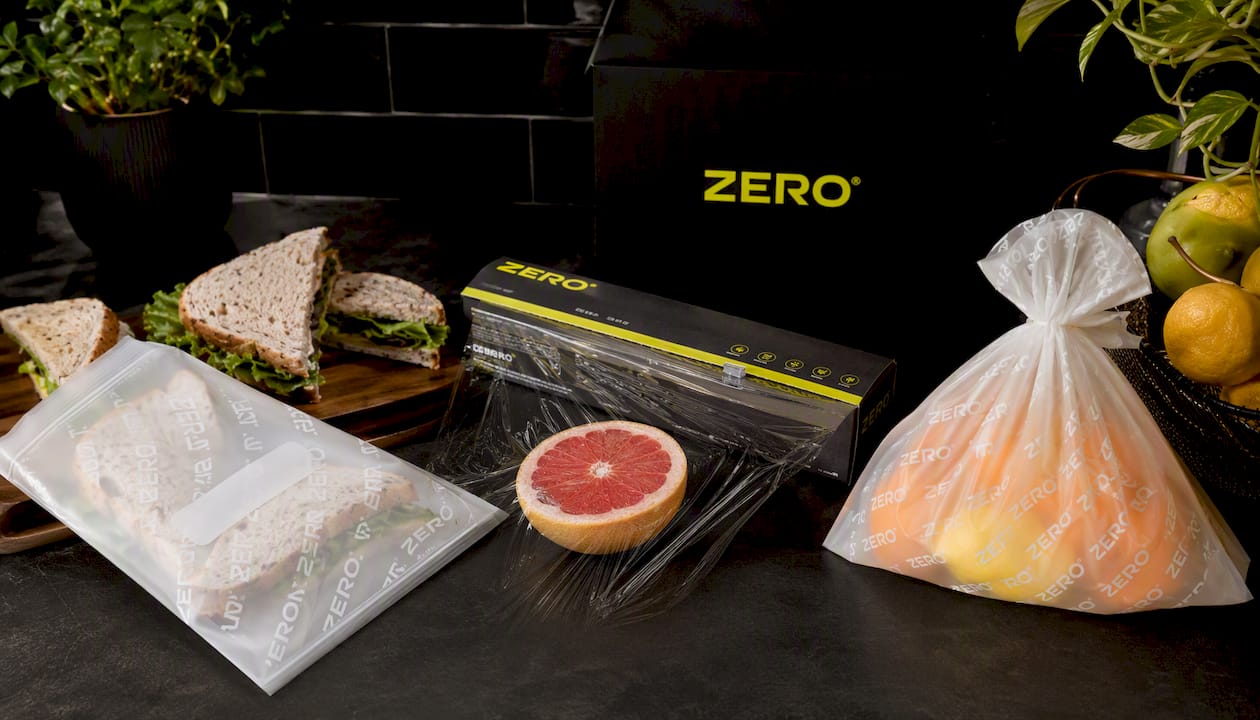
For a cling film replacement, the Plastic-Free Cling Wrap is home compostable and priced from $6.99 AUD. For kitchen storage that gets reused rather than binned each time, the Plastic Free Resealable Food Storage Bags start from $4.99 AUD. If loose fruit and veg are the gap in your plastic-free setup, the Plastic Free Produce Bags (2 Pack) run $79.95 AUD, or browse the full kitchen collection to compare all three against what’s currently in your kitchen drawer.
Sources
- Examining sustainability claims of bioplastics (UTS)
- Transition to bio-based plastic packaging reveals complex climate–biodiversity trade-offs (Nature Communications)
- Bioplastics: an examination of variety, degradation, and environmental effects (IOPscience)
- Biodegradability of Bioplastics in Managed and Unmanaged Environments: A Comprehensive Review (MDPI)
FAQ
Are bioplastics better than conventional plastic?
They’re better on some measures, notably lifecycle carbon emissions, but not universally better. Land-use and biodiversity impacts can rise with first-generation bio-based feedstock, and the UTS review found ecosystem damage can increase three to five times in some substitution scenarios.
What are the downsides of using bioplastics?
The main downsides are land and water use during feedstock growing, inconsistent biodegradation depending on polymer and environment, and a real risk of microplastic fragmentation or leaching during ageing if they don’t reach proper composting conditions. Reviews also note some bioplastics can be as toxic as conventional plastic in certain lab assays.
Why isn’t bioplastic more widely used?
Cost and infrastructure are the two biggest barriers: bioplastics are typically pricier to produce at scale, and industrial composting facilities capable of processing them aren’t available everywhere. Without local collection and composting access, even certified compostable bioplastics often end up in landfill rather than breaking down as intended.
How long does bioplastic take to break down?
It depends entirely on the polymer and environment. PHAs and starch-based materials can biodegrade in soil or water within months, while PLA generally needs sustained industrial composting temperatures to break down within a similar timeframe, and can persist for years if it ends up in landfill or the ocean instead.
Share:
Dishcloths Vs Sponges for Eco Kitchens: Cloths Absorb 15–20× More
6–12 Weeks in Industrial Composting, What Compostable Bags Mean to Consumers