
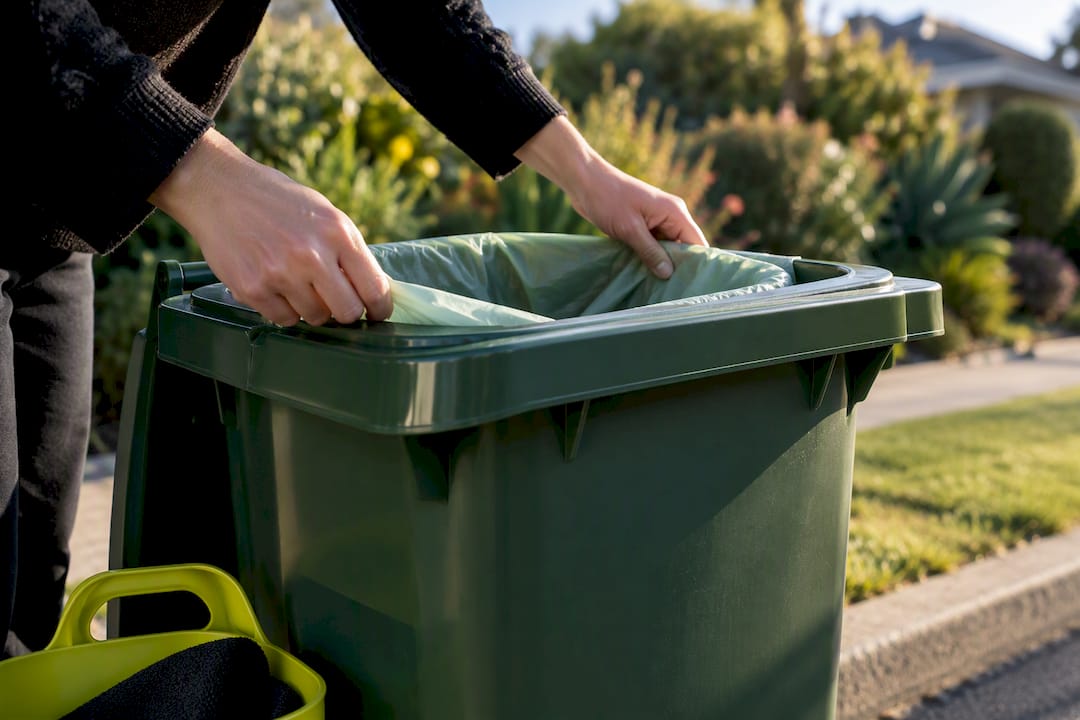
You can put compostable bags in your green (FOGO) bin, but only if they are certified to AS4736 or supplied by your council. Home compostable bags marked AS5810, and anything simply labelled “biodegradable”, are usually rejected. If you are unsure, check your council’s website first or line your caddy with newspaper instead.
TL;DR:
- Only bags certified to AS4736 or supplied by your council are reliably suitable for industrial composting; home compostable bags marked AS5810 are generally rejected.
- Councils prefer certified liners because they are tested for proper breakdown in commercial facilities, which operate at high temperatures and specific conditions.
- Using non-certified biodegradable or degradable bags risks contamination, rejected loads, and lower quality compost due to plastic fragments, affecting the entire processing system.
- Storage of unused compostable liners in a cool, dry place extends their shelf life beyond the typical two to four days used in active bins.
- Alternative waste bags for food scraps, nappies, or pet waste made from bio-polymers should always be checked against local council policies before use.
Table of Contents
- Why Australian councils require AS4736 industrial compostable standards
- What councils actually say about liners, delivery and spare packs
- How to choose, use and store compostable liners properly
- What happens when you use the wrong bag
- Where household products like The Zero Store’s fit into your routine
- Small household habits that protect the whole compost system
- Everyday plastic-free swaps that pair well with a compostable routine
- Authoritative council pages and standards to check
- Sources
- FAQ
Why Australian councils require AS4736 industrial compostable standards
AS4736 and AS5810 sound similar but cover completely different composting conditions. AS4736 certifies that a bag will break down in a commercial or industrial composting facility, the kind of large-scale operation councils use to process FOGO waste. AS5810 certifies home composting performance instead, which relies on far gentler conditions than a council facility provides.
Industrial composting facilities run at sustained high temperatures for set periods, breaking down organic matter and packaging far faster and more completely than a backyard compost heap ever could. A bag that passes AS5810 in a slow, cooler home compost bin has no guarantee it will fully disintegrate within the timeframe of a commercial process. That mismatch is exactly why councils draw a hard line between the two standards.
The City of Melbourne states that liners for FOGO bins need to be certified to AS4736, and that home-compostable or generic biodegradable bags are often not accepted because they can contaminate the finished compost. This is not council pedantry. It reflects a genuine difference in how these materials perform under industrial processing.
Practically, that leaves you with three reliable liner options:
- Certified AS4736 bags: look for the standard number printed on the packaging or a recognised compostable certification logo.
- Council-supplied green bags: distributed specifically for your area’s FOGO system and pre-approved for collection.
- Paper alternatives: plain newspaper or paper towel, which carry no certification risk at all.
Anything outside those three categories is a gamble, and the person taking the risk is whoever ends up sorting a contaminated load at the processing facility.
What councils actually say about liners, delivery and spare packs
Council rules vary slightly by area, but the pattern across Australia is consistent: most councils either supply approved green compostable bags directly or point residents towards a specific certified product, and they actively discourage anything else.
Penrith City Council states that its council-provided green compostable bags are the only bags specifically designed and tested to break down during its commercial composting process. Residents are advised against substituting other brands, even ones marketed as compostable, and paper or newspaper is offered as the fallback option when bags run out.
Several other councils follow a similar model, with variations mainly in how liners are distributed:
- Penrith City Council issues free green compostable bags to residents and advises against using unapproved alternatives.
- City of Melbourne publishes clear guidance on which liner standards it accepts and why non-certified bags cause problems downstream.
- City of Melville allows residents to collect extra packs of approved liners from civic centres when their initial supply runs low.
- Lake Macquarie City Council permits either council-provided liners or plain paper, while explicitly warning against ordinary plastic or “degradable” bags.
Some councils run periodic delivery cycles, dropping a set number of bags to households annually, while others rely on residents picking up spare packs from a library, civic centre or council depot. A handful of areas have trialled different distribution models altogether. The Holdfast Bay trial tested how compostable liners performed and how effectively they could be distributed within a local FOGO system, feeding directly into decisions about which bags councils choose to support.
If your bag supply is running low or you are not sure what your council allows, the fastest fix is checking your local council’s waste page directly or calling customer service. Rules genuinely differ from one local government area to the next, and a bag that is fine in one council can be a contamination risk in another.
How to choose, use and store compostable liners properly
Getting this right day to day is less about knowing the standards and more about a few consistent habits.
- Check the label before you buy. Look for “AS4736” printed on the packaging, or a certification mark from a recognised compostable products scheme. If the packaging only says “biodegradable” or “eco-friendly” with no standard number, treat it as unapproved.
- Match the bag to your caddy. Most kitchen caddies take a standard 7 to 10 litre liner. Buying the wrong size leads to overhang, tearing, or bags that slip and spill.
- Empty the caddy every two to three days. Compostable liners are designed to start breaking down once conditions are right, so leaving scraps too long risks the bag weakening before it reaches the bin.
- Handle wet scraps carefully. Very wet waste such as melon rinds or leftover soup can soak through a liner faster than solids. Draining excess liquid first, or freezing particularly wet scraps until collection day, extends the bag’s working life.
- Skip the knot if your council says so. Some councils ask residents not to tie liners shut, since a sealed bag can slow the composting process. Check your local guidance before knotting bags out of habit.
- Use no liner at all when in doubt. Caddies can be lined with nothing, then rinsed out after each empty. It is slightly more effort but removes any risk of using the wrong bag.
Storage matters more than most people expect. The City of Melville notes that liners typically last two to four days once in active use, and recommends keeping unused packs somewhere cool, dry and out of direct sunlight. Heat and humidity can start breaking a compostable bag down before it ever reaches your caddy, which defeats the purpose of buying it in the first place.
Newspaper is the fallback that never lets you down. It has no certification requirements to check, breaks down easily in industrial composting, and costs nothing extra if you already have it lying around.
Pro Tip: Line the base of your caddy with a sheet of absorbent paper before adding a compostable bag. It soaks up excess moisture and can add an extra day or two to how long the liner holds up.

What happens when you use the wrong bag
Non-certified bags cause more damage than most householders realise, and the consequences land well beyond your own kitchen bin.
Some products marketed loosely as “biodegradable” or “degradable” do not fully break down in composting conditions. Instead, they fragment into small pieces of plastic that mix into the finished compost. Several council pages, including guidance referenced by Penrith City Council, warn residents specifically that these bags break down into tiny pieces of plastic rather than composting properly, which is why they are excluded from FOGO systems.
The knock-on effects are practical and immediate:
- Rejected loads: a bin found with unapproved bags can have its entire load bypassed rather than collected.
- Non-collection notices: many councils leave a tag on the bin explaining why it was not emptied, requiring you to fix the issue before the next pickup.
- Extra sorting costs: contaminated loads sometimes need manual sorting at the processing facility, adding cost and slowing the whole system.
- Lower compost quality: plastic fragments that make it through processing lower the value and safety of the finished compost product.
Contamination from a single household rarely stays contained to that one bin. Loads are processed in bulk, so a batch of non-certified bags in a truckload of FOGO waste can affect the quality of compost produced from that entire run, according to guidance from councils including the City of Melbourne.
If you receive a non-collection notice, check the tag for the stated reason, remove the offending bag or item, and switch to a certified liner or paper before your next collection day. Repeated issues are usually worth a call to your council’s waste team, since some will talk you through exactly what triggered the rejection.
Where household products like The Zero Store’s fit into your routine
Certified liners solve the bin itself, but plenty of household waste never makes it that far without the right bag first. Some eco-friendly brands offer items relevant to that gap in a typical Australian kitchen and laundry routine.
- Plastic Free Produce Bags (2 Pack): reusable produce bags for fruit and vegetables, reducing single-use plastic before food scraps even reach the caddy.
- Plastic Free Nappy Waste Bag: designed for capturing nappy waste separately from general household rubbish.
- Puppy Waste Bag: a plastic-free option for dog waste, kept apart from FOGO or general waste streams.
These are made from bio-polymers including PLA, PHA and PBAT rather than conventional plastic film. They are built for capture and storage tasks around the home, not as a substitute for your council’s certified green bin liner.
That distinction matters in practice. Nappy and puppy waste bags are generally intended for general waste bins, not the green bin, since most councils explicitly exclude these waste types from FOGO collection regardless of what the bag itself is made from. Before using any product as a bin liner of any kind, check your specific council’s current policy, since accepted items and approved bag types differ by area and can change.
Small household habits that protect the whole compost system
Following your council’s liner rules feels like a minor chore until you consider what is actually at stake: a shared composting system that only works if everyone puts the right material in. One household’s shortcut with an unapproved bag becomes another community’s contaminated compost batch. That is not a guilt trip, it is just how bulk processing works.
Two habits make compliance genuinely easy rather than a source of friction. First, keep a spare roll of certified or council-supplied liners on hand so you are never tempted to grab whatever plastic bag is nearest when you run out. Second, keep a stack of newspaper by the caddy as a permanent backup, since it never needs checking against a standard.
Small, boring consistency is what keeps a FOGO system working at scale.
— Damien
Everyday plastic-free swaps that pair well with a compostable routine
Sorting food scraps properly is one habit. Reducing the plastic that enters your kitchen in the first place is another, and The Zero Store’s range covers a few practical gaps in between.

The Plastic Free Produce Bags (2 Pack) work well for loose fruit and vegetables, cutting down on single-use plastic before anything reaches your caddy. For nappy waste, the Plastic Free Nappy Waste Bag gives you a plastic-free way to bag and store waste separately from general rubbish. Dog owners can reach for the Puppy Waste Bag, a plastic-free option for daily walks.
- Produce bags reduce single-use plastic at the grocery stage, before food scraps ever reach your FOGO caddy.
- Nappy and puppy waste bags give you a plastic-free option for waste types that generally belong in general rubbish, not the green bin.
Always check your council’s current policy before using any bag as a bin liner. Browse the full range in the kitchen collection or the baby collection to see what fits your household.
Authoritative council pages and standards to check
Rules shift between councils and get updated periodically, so it is worth bookmarking a few primary sources rather than relying on memory.
- City of Melbourne FOGO service: standards accepted and reasons for exclusions.
- Penrith City Council FOGO FAQ: council-supplied bag policy and paper alternatives.
- City of Melville compostable liners guidance: liner lifespan and spare pack collection.
- Holdfast Bay compostable bag trial report: local trial evidence on distribution and performance.
- A small kitchen caddy such as the 10L waste separation bin from Keter Australia. It pairs easily with certified liners for everyday food-scrap collection.
Always check your own council’s website for the exact rules and distribution programs in your area, since these details are set locally.
Sources
- Food and garden organics (FOGO) | City of Melbourne
- FOGO FAQ - Penrith City Council
- FOGO liners and buying FOGO-derived compost | City of Melville
- Holdfast Bay compostable bag trial project report (2020)
FAQ
Do compostable bags go in the green bin?
Only if they are certified to AS4736 or supplied directly by your council. Home compostable bags marked AS5810, and generic “biodegradable” bags, are typically not accepted because they are not designed for industrial composting conditions, according to guidance from the City of Melbourne.
Why are compostable bags not allowed?
Some bags marketed as biodegradable or degradable do not fully break down in industrial composting and instead fragment into small pieces of plastic. Councils exclude these to avoid contaminating the finished compost, a concern flagged explicitly by Penrith City Council.
Are green compostable bags actually compostable?
Council-supplied green compostable bags are tested specifically for that council’s commercial composting process, which is different from a home compost bin. Penrith City Council, for example, states its supplied bags are the only ones specifically designed and tested to break down during its composting process.
What bag to use for a green bin?
Use a bag certified to AS4736, or the specific bag your council distributes for its FOGO service. If you run out or are unsure, plain newspaper or paper towel is a safe fallback accepted by most councils, including Lake Macquarie City Council.
How long do compostable liners last before use?
Once in active use lining a caddy, compostable liners typically hold up for two to four days, according to guidance from the City of Melville. Unused packs last longer if stored somewhere cool, dry and out of direct sunlight.
Share:
Australians: Keep Hot, Fatty Food Safe with Phthalate Free Storage
Dispose Nappies Without Plastic in Australia: Check AS 4736/5810