
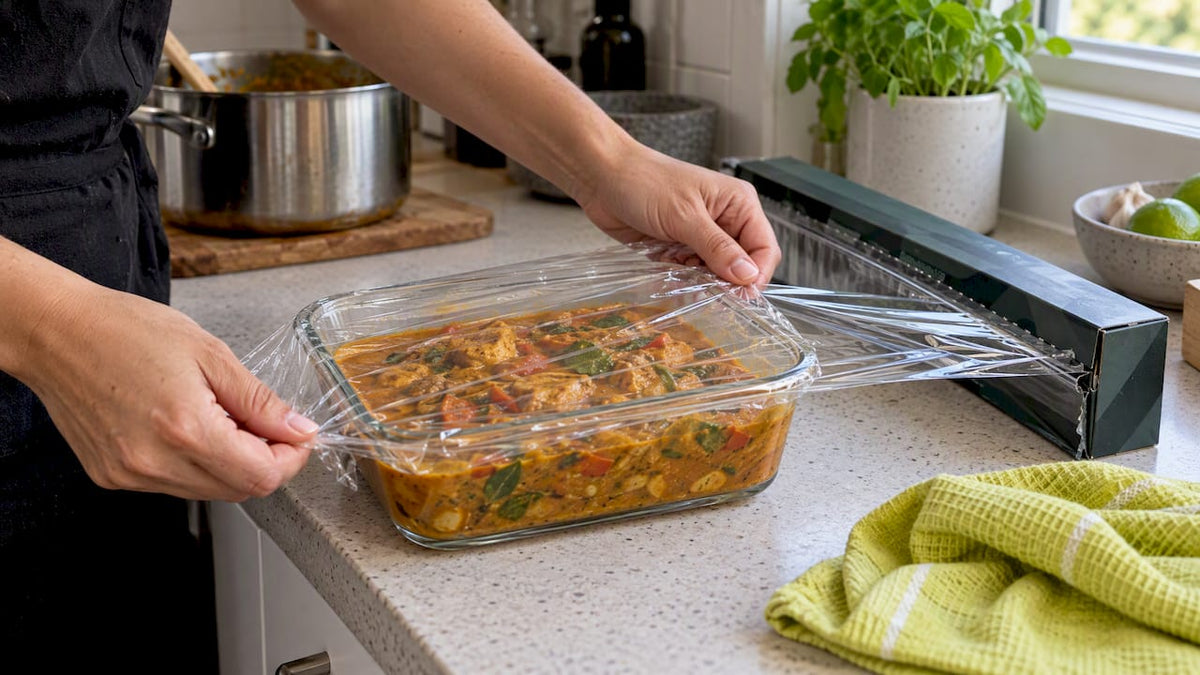
Glass and stainless steel are the safest bet for phthalate free food storage, especially for anything hot, fatty or acidic. Avoid flexible PVC containers and wraps, check that seals and lids carry their own phthalate free claim, and never reheat fatty or acidic food in a plastic container of unknown origin. Products such as plastic-free cling wrap offer a straightforward swap for shoppers who want to skip the guesswork entirely.
TL;DR:
- The safest storage options for hot, fatty, or acidic food are glass and stainless steel with food-grade silicone seals, to avoid chemical migration risks.
- Phthalate presence in food packaging is mainly linked to flexible plastics like PVC, especially under heat or in contact with fats, but population-level exposure remains low according to FSANZ data.
- Always verify that “phthalate free” claims are specific to every component, including lids and seals, with explicit certification to prevent hidden risks from soft plastics or unverified materials.
- Reheating leftovers in plastic containers of unknown origin or soft wraps increases migration, so transfer hot or oily food to non-plastic, inert containers before heating.
- Choosing bio-polymer based plastic-free wraps and resealable bags, such as those made from PLA or PBAT, can reduce plastic waste and airborne chemical exposure without sacrificing convenience.
Table of Contents
- What ‘phthalate-free’ actually means for food contact materials
- Materials compared: glass, stainless steel, silicone and plastic
- How migration happens and simple safe-use rules
- Quick buying checklist: what to verify before you buy
- How plastic-free products respond to these risks
- Why proportionate caution beats either panic or complacency
- Practical options for everyday plastic-free storage
- Sources
- FAQ
What ‘phthalate-free’ actually means for food contact materials
Phthalates are a group of chemicals added to plastics, most often PVC, to make them soft and flexible. They turn up in cling film, some gasket seals, printed labels and squeeze bottles, and they are not chemically bound to the plastic, so they can migrate into whatever the plastic touches.
A container marketed as “phthalate free” only means something if the claim covers every part that touches food: the body, the lid, the seal or gasket, and any printed ink on the inside surface. A rigid container with a soft silicone seal that is not separately verified can still carry phthalates in that one component, even if the main body is clean.

This is why FSANZ monitoring matters. Its chemical-migration survey tested 65 foods and beverages and found no phthalate detections in those samples, while reminding manufacturers that packaging must remain fit for its intended use under Australian food law. That finding is reassuring at a population level, but it does not replace checking the specific product you are buying, since formulations vary between brands and batches.
Materials compared: glass, stainless steel, silicone and plastic
Each material behaves differently once heat, fat or acid enters the picture, so the right choice depends on what you are storing and how you plan to use it.
- Glass: Non-reactive and the safest option for heating, acidic foods like tomato sauce, and fatty leftovers, provided the lid seal is food-grade and intact.
- Stainless steel: Durable and low-migration, but it is not microwave-safe and needs a compatible lid for liquids.
- Food-grade silicone: A practical choice for seals, lids and flexible storage, but confirm the food-grade marking rather than assuming all silicone qualifies.
- Flexible PVC and soft plastics: Higher risk because softening agents are more likely to migrate, particularly under heat or with oily contact, so these are the materials to avoid for hot or fatty food.
Rigid plastics such as polypropylene can be reasonable for dry, cold or short-term storage, but they are not interchangeable with glass or steel for anything hot or acidic. When in doubt, the simplest rule is to match the material to the job: glass or steel for heat and acid, silicone for seals and flexibility, and caution around anything soft, cheap or unlabelled.
How migration happens and simple safe-use rules
Migration is not random. A 2025 systematic review covering 67 studies and 5,378 samples found that phthalate transfer from packaging into food depends heavily on temperature, contact time, acidity and fat content, with higher-fat foods showing the most consistent concentration of migrating compounds. Australian data tells a similar story: a survey of plasticisers in Australian foods found that 91% of results sat below the limit of quantification, but the highest concentrations turned up in a small number of fatty foods, and a follow-up 24th Australian Total Diet Study screening 81 foods for 30 packaging chemicals flagged two phthalates, DEHP and DINP, for further targeted study after some conservative exposure estimates exceeded guidance values in limited samples.
In practice, this translates into a short list of habits:
- Avoid reheating fatty or acidic leftovers in containers or wraps you cannot confirm are phthalate free.
- Stick to the temperature range printed on the container, whether that is microwave, oven, freezer or dishwasher.
- Replace lids, gaskets or cling wraps that have cracked, clouded or lost their shape, since degraded plastic migrates more readily.
A takeaway curry reheated in its original soft plastic tub, or cling film draped directly over a hot, oily dish, are both everyday examples of the riskiest combination: heat, fat and unknown plastic in direct contact.
Transfer leftovers to a glass or stainless-steel container before reheating, rather than trusting the tub they arrived in.
Quick buying checklist: what to verify before you buy
A few minutes of checking at the point of purchase does more than any amount of worry afterwards.
- Check the vessel body and the seal or lid separately, since each is a different material with its own claim.
- Look for an explicit phthalate-free statement alongside any material datasheet, certification or test result the manufacturer publishes.
- Confirm the intended temperature range for microwave, oven, freezer and dishwasher use before relying on it.
- Skip PVC-based wraps or containers for hot or oily food, and consider a plastic-free alternative for anything you will reuse long-term.
Retail listings for things like a 2000ml food container with lid are a useful reference point for how manufacturers typically spell out seal material and temperature limits, which is exactly the detail worth comparing before you buy. Broader buying guides, such as those on Kitchenware Compare, can also help you cross-check appliance compatibility claims against independent reviews.
How plastic-free products respond to these risks
Reducing phthalate exposure and cutting single-use plastic are two separate goals that happen to point in the same direction. Plastic-free cling wrap and resealable storage bags made from bio-polymers such as PLA, PHA and PBAT avoid the flexible PVC formulations where phthalate risk concentrates, and they sidestep the single-use plastic question at the same time.
The Zero Store’s range, including resealable food storage bags and produce bags, is built around that same materials-first logic: know what touches your food, and choose accordingly. Shoppers who want certification details or manufacturer datasheets for a specific product should check the listing directly, since claims vary by format and pack size.

Why proportionate caution beats either panic or complacency
The evidence does not support throwing out every plastic container in the house, and it does not support ignoring the issue either. FSANZ’s own monitoring found no phthalate detections across 65 tested foods, yet flagged specific fatty foods and two compounds for further study, which is a textbook case for targeted caution rather than blanket alarm.
Where conventional advice falls short is in treating “BPA-free” as a stand-in for “safe”, when BPA and phthalates are entirely different chemical families with different risk profiles. A label addressing one says nothing about the other. The reader’s best first move is not buying an entirely new kitchen, it is auditing what already touches hot, fatty or acidic food and swapping only those pieces, since that is where migration evidence concentrates. Durability matters too: a glass container bought once and used for years does more for both health and sustainability than a drawer full of mismatched plastic tubs.
— Damien
Practical options for everyday plastic-free storage
Covering a bowl of leftovers, packing a lunch or carrying produce home are three different jobs, and The Zero Store’s range is built around that split. Plastic-free cling wrap works for covering dishes without reaching for a PVC-based film, resealable bags suit packed lunches and snacks, and produce bags handle fruit and vegetables without a single-use plastic bag.

All three sit within the broader kitchen collection, where material details and intended use are listed against each product. If your household is also looking at cleaning or baby care, the same plastic-free approach carries through to the cleaning range and baby wipes and nappy waste bags.
Sources
- Chemicals in food packaging | Food Standards Australia New Zealand
- Occurrence of phthalates in different food matrices: a systematic review of the main sources of contamination and potential risks - PubMed
FAQ
What is the safest material for food storage containers?
Glass and stainless steel are generally the safest choices because they are non-reactive and do not contain the plasticisers used in soft plastics. Pair either with a confirmed food-grade silicone seal, since the seal is a separate material that needs its own check.
What are some non-toxic food storage containers?
Borosilicate glass containers with silicone lids, stainless-steel containers, and reusable silicone lids are common non-toxic formats sold in Australia. Each should carry its own phthalate free and food-grade statements rather than relying on the main body’s labelling alone.
What are the best plastic-free storage options for everyday food?
Plastic-free cling wrap and resealable bags made from bio-polymers such as PLA and PBAT avoid the flexible PVC where phthalate risk concentrates. Glass containers remain the better choice specifically for hot, fatty or acidic leftovers that need reheating.
Are phthalates harmful in food packaging?
FSANZ’s monitoring found no phthalate detections across 65 tested foods and beverages, suggesting population-level exposure through packaging is generally low. A 2025 review of 67 studies still found migration increases with heat, fat content and contact time, so risk depends heavily on how a specific plastic is used.
How do I know if a product is truly phthalate-free?
Check that the claim covers the vessel body, the lid, the seal and any printed surface, not just the main container material. A manufacturer’s datasheet or explicit statement for each component is more reliable than a single general label on the packaging.
Share:
Freeze Bread Without Plastic in Australia: Keep It Fresh 2–3 Months
Stop Guessing: 3 Liner Options That Australian Green Bins Accept