
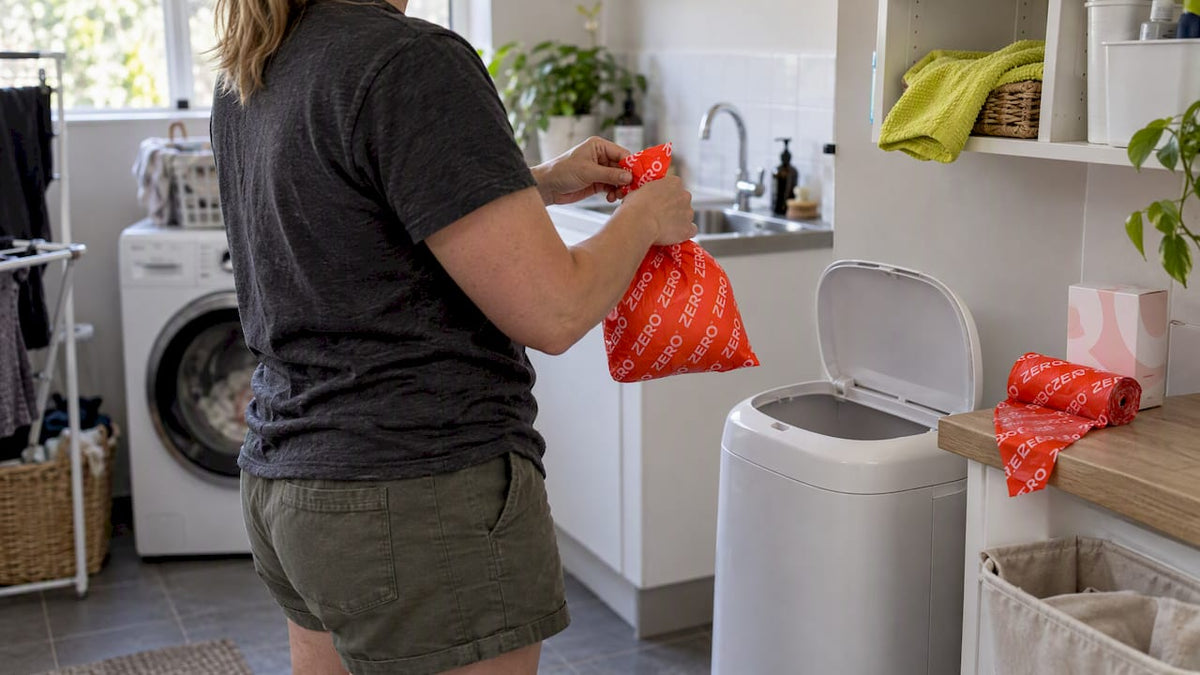
The realistic plastic-free options right now are refill-free nappy bins, certified compostable sacks where your council accepts them, cloth nappies, and dropping off at one of the emerging industrial composting trials. None of these work everywhere automatically: certified compostable only means something if a facility near you processes it, so check the packaging for an Australian Standard and confirm with your council before you commit to a system.
TL;DR:
- Certified compostable sacks are effective only if processed in facilities approved by your council, so check local acceptance before use.
- Replacing plastic liners with refill-free bins removes one layer of packaging but does not change the landfill destination of the nappy itself.
- Cloth nappies can be environmentally preferable for large-volume households, but they increase water and energy use for laundering.
- Most Australian councils do not accept compostable nappies in green waste unless part of specific local trials, so confirm eligibility beforehand.
- Households should focus on a chain of small plastic reductions, such as swapping wipes and kitchen wraps, rather than relying solely on one change.
Table of Contents
- Why nappy disposal matters more than people think
- Practical plastic-free disposal options you can adopt at home
- Does your council actually accept compostable nappies?
- How to choose the best plastic-free system for your household
- Is home composting nappies actually feasible?
- Plastic-free versus traditional nappy disposal: what actually changes
- Cutting plastic at every stage, not just at the bin
- Hygiene still comes first, whatever material you choose
- Finding the balance between convenience and doing it properly
- A practical plastic-free nappy bag for everyday use
- Where to check the claims in this guide
- Sources
- FAQ
Why nappy disposal matters more than people think
Disposable nappies make up a sizeable share of household waste that goes straight to landfill, and parents often assume the “biodegradable” claim on a packet means the job is done once the nappy leaves the house. It rarely is.
A standard disposable nappy combines a plastic outer shell, a cellulose core and superabsorbent polymer (SAP), the gel-like material that locks away moisture. In a sealed landfill cell, with little oxygen or moisture movement, that mix can persist for a long time rather than breaking down the way food scraps do.
- Plastic outer layers resist breakdown in low-oxygen landfill conditions.
- SAP is not readily biodegradable and is one of the biggest technical barriers to a fully compostable disposable nappy.
- A “biodegradable” label only means something in the environment it was designed for, not automatically in landfill or your backyard bin.
Disposable nappies constitute a significant proportion of municipal waste, and government inquiries into absorbent hygiene product waste have recommended trials, education and council-level solutions to divert them from landfill rather than relying on packaging claims alone.
Practical plastic-free disposal options you can adopt at home
The options that actually reduce single-use plastic fall into three broad categories, each with trade-offs worth knowing before you switch.
Refill-free or cartridge-free nappy bins skip the proprietary plastic film cassette that standard nappy bins rely on. Instead, you line the bin with your own bag, a nappy waste bag or whatever your council accepts, which cuts out a recurring plastic purchase entirely and lets you choose the liner material yourself.
Certified compostable sacks are the trickiest category because the labelling matters more than the marketing. Look for AS 4736 (industrial composting) or AS 5810 (home composting) printed on the packet. According to Geelong City Council’s guidance on compostable labelling, these are the two standards that matter in Australia, and a product certified to one does not automatically qualify for the other. A bag rated AS 4736 needs an industrial facility; putting it in a home compost bin will likely leave you with intact plastic months later.

Reusable or cloth nappies remove single-use packaging from the equation but shift the environmental cost to water and energy use for laundering. For households with access to a washing machine and the time for an extra load every few days, cloth is often the lowest-waste option over the nappy’s whole life, though it is the most hands-on.
Pro Tip: Keep a small stash of certified compostable sacks for outings and cloth or a refill-free bin for home, rather than trying to force one system to cover every situation.
Single-use compostable nappies themselves remain limited by the SAP problem: even a fully compostable outer shell does not solve what happens to the absorbent core, which is why reviews of biodegradable diaper alternatives flag SAP replacement as a major unresolved barrier.
Does your council actually accept compostable nappies?
A certified compostable nappy sack is only as good as what happens to it after collection, and that depends entirely on local infrastructure rather than the packet.
Green waste and FOGO (food organics, garden organics) services vary enormously between councils. Some accept certified compostable products in general green waste, some runs separate absorbent hygiene product trials, and many simply do not have a processing agreement in place yet. The Geelong City Council guidance is explicit that acceptance follows local trials and agreements with a specific processor, not a blanket rule.
Two Australian projects show what’s possible once that infrastructure exists:
- The CSIRO-backed Nappy Loop project demonstrated that anaerobic digestion can convert the organic fraction of used nappies into compost and biogas, separating plastics out for later handling.
- The Bega Valley Shire trial successfully processed certified compostable nappies through a commercial FOGO facility, proving the model works at a local scale.
Both remain specialised rather than nationwide services, so before you change anything, call your council’s waste line and ask directly whether compostable nappies are accepted, under what certification, and whether there’s a drop-off point if kerbside collection isn’t an option. Store used nappies in a sealed, odour-controlled bag until collection day regardless of which system you use, since hygiene doesn’t change just because the material does.
How to choose the best plastic-free system for your household
Match the method to your actual routine rather than the most appealing claim on a packet.
- Household size and nappy volume: more nappies means storage and odour control matter more than cost per unit.
- Storage space: a refill-free bin needs somewhere to sit; cloth needs a wet bag and laundry capacity.
- Local acceptance: confirm with your council whether compostable sacks go anywhere other than general waste before buying in bulk.
- Cost over time: cloth has a higher upfront cost and lower ongoing spend; sacks and liners are the reverse.
Check packaging for AS 4736 or AS 5810 specifically, and for explicit processing instructions rather than vague green leaf icons. The EPA Victoria guidance on biodegradability and compostability is blunt on this point: a product that biodegrades in an industrial facility often will not break down in home compost or landfill, so the claim only holds if the environment matches the certification.
Pro Tip: Treat any bag or nappy marketed as “eco-friendly” with no AS number on the pack as unverified, and ask the retailer directly which standard it meets.
Ask your council two direct questions: which absorbent hygiene products, if any, are accepted in FOGO, and is there a local trial you can join. A vague answer or no answer is the clearest red flag that a compostable claim won’t translate into real diversion from landfill in your area.
Is home composting nappies actually feasible?
Composting a used nappy in your own backyard bin is not recommended, even with a certified AS 5810 “home compostable” sack. Home compost systems rarely reach the sustained heat and microbial activity of an industrial facility, and human waste in a backyard system raises genuine hygiene concerns around pathogens that a household bin isn’t built to manage safely.
Where AS 5810 certification applies, it’s usually to the bag itself rather than to co-composting it with faecal waste in a suburban backyard bin. The safer DIY approach is to separate solid waste into the toilet where practical, especially once a baby moves to solids, and use the compostable or reusable liner purely for the bag and wipes.
If you’re set on a more hands-on approach, a dedicated worm farm or hot compost system built specifically for pet or human waste, kept separate from your food garden compost, is a different proposition to tossing a nappy into the same bin as vegetable peelings. Even then, treat it as a household experiment rather than an endorsed disposal method, and never use the resulting compost on edible plants.
For most households, the practical version of “DIY” is simpler: a refill-free bin lined with a certified sack, emptied into general waste or a local trial collection, rather than attempting to compost nappies at home.
Plastic-free versus traditional nappy disposal: what actually changes
The honest comparison isn’t plastic-free nappies against plastic nappies, it’s where the waste ends up either way.
A standard disposable in a standard nappy bin liner goes straight to landfill, where the plastic outer shell and SAP persist for a long time in low-oxygen conditions. Switching only the liner, from a plastic cassette to a refill-free bin, doesn’t change where the nappy itself ends up, it only removes one layer of packaging plastic from the system.
Switching to a certified compostable nappy changes the outcome only if it reaches the right facility. Trials like Nappy Loop show that industrial anaerobic digestion can separate plastics from organics and generate compost and biogas from the organic fraction, a genuinely different endpoint to landfill. But that pathway depends on local collection and facility capacity, so the environmental benefit exists on paper until your council or a trial actually provides it.
Cloth nappies shift the impact away from landfill entirely and toward water, detergent and energy use for washing. That trade-off tends to favour cloth over a full-time disposable habit, but it isn’t free of environmental cost either, it’s a different cost.
The clearest net gain across the board is reducing the plastic volume entering the system in the first place, whether that’s a refill-free bin, a certified sack, or fewer single-use wipes, rather than assuming any single swap solves landfill volume on its own.
Cutting plastic at every stage, not just at the bin
Plastic reduction works best as a chain of small swaps rather than one big switch.
Start with wipes: a standard baby wipe often contains plastic fibres, so swapping to a plastic-free version removes one more item from the landfill stream every single change. The Zero Store’s Baby Wipes are one example of a plastic-free alternative built for this exact swap.
Next, look at the nappy sack itself rather than only the outer bin liner, since a standard scented nappy bag is usually conventional plastic film regardless of how “eco” the bin looks. A certified compostable or genuinely plastic-free sack closes that gap.
Finally, check your kitchen and cleaning routines for the same pattern: cling film, snap-lock bags and disposable cloths add up over a year the same way nappy liners do. Reusable or plastic-free versions of cling wrap and resealable food storage bags follow the same logic as a refill-free nappy bin, removing a recurring single-use plastic purchase rather than replacing it with another one.
- Swap scented plastic nappy sacks for certified compostable or plastic-free bags.
- Choose plastic-free wipes over standard wet wipes containing synthetic fibres.
- Apply the same swap logic to kitchen wrap, produce bags and cleaning wipes.
None of these swaps alone solves landfill volume, but together they reduce the total plastic a household sends out the door each week.
Hygiene still comes first, whatever material you choose
Switching to a plastic-free system doesn’t change the basic hygiene rules around nappy waste, and treating it as if it does is where mistakes happen.
Used nappies still carry bacteria and, for a baby not yet on solids, pathogens that need containing regardless of bag material. A certified compostable sack should still be sealed tightly and stored in a bin with a lid, the same as a conventional one, rather than left loosely bagged because it “breaks down anyway.”
Cloth nappies raise a different hygiene question: a wet bag for soiled cloth needs washing regularly at a high enough temperature to deal with bacteria, and a nappy left too long in a sealed bag before washing can develop odour and mould issues faster than a single-use nappy in general waste.
Wherever you’re storing nappies before collection or washing, keep the bin or bag away from food preparation areas and wash your hands after handling, exactly as you would with any disposable system. Plastic-free materials solve a landfill problem, not a hygiene one, and the two shouldn’t be confused when you’re setting up a new routine.
Finding the balance between convenience and doing it properly
Most households won’t go fully cloth or wait for a council trial to start. What works is layering the easy wins, a refill-free bin, a genuinely certified sack, plastic-free wipes, on top of whatever routine already fits your life. Some eco-friendly stores build their range around exactly that kind of practical swap.
— Damien
A practical plastic-free nappy bag for everyday use
If you want one straightforward swap that fits whatever bin or bag system you’re already running, The Zero Store’s Plastic Free Nappy Waste Bag is built for exactly that gap between what a standard nappy sack offers and what a genuinely plastic-free household needs.

- Fits a refill-free bin at home or a nappy bag for outings, without needing a proprietary cassette.
- Made as a plastic-free alternative to standard scented nappy sacks.
- Priced at $14.95 for the pack, available through The Zero Store’s baby collection alongside plastic-free Baby Wipes.
The same approach applies beyond the nursery: a Puppy Waste Bag covers the same plastic-free logic for dog walks, and both sit alongside The Zero Store’s wider range of kitchen and cleaning essentials if you’re cutting plastic across the whole house rather than one room at a time. Check the nappy bag collection to see current stock and pack sizes.
Where to check the claims in this guide
Before changing your household system, verify locally rather than relying on packaging alone. Geelong City Council’s compostable labelling guidance explains the AS 4736 and AS 5810 standards, while the Nappy Loop project and the Bega Valley trial show what working industrial composting looks like. Always confirm acceptance with your own council’s waste services page, since trial results don’t guarantee a service near you. Commercial waste programmes, such as those described in 360 Cleaning’s guide to sustainable business waste practices, show how the same separation principles apply outside the household.
Sources
- Compostable labelling — Geelong City Council
- Australian-first nappy recycling trial - CSIRO
- Bega Valley compostable nappy trial success garners global attention - ABC News
- Feasibility and implications of biodegradable diaper alternatives - MDPI (Sustainability)
FAQ
What can I use instead of plastic nappy bags?
Certified compostable sacks, marked with AS 4736 or AS 5810, are the main plastic-free alternative, along with reusable wet bags for cloth nappies. Check your council accepts compostable sacks in green waste before relying on them, since the material has to match an approved disposal pathway to break down as intended.
Are any nappies fully biodegradable?
No current disposable nappy is fully biodegradable because the superabsorbent polymer core remains a major technical barrier even in certified compostable designs, according to recent research into biodegradable diaper alternatives. Outer layers can be certified compostable under AS 4736 or AS 5810, but the absorbent core typically cannot.
How do I dispose of nappies at home sustainably?
Use a refill-free bin lined with a certified compostable sack where your council accepts it, or switch to cloth nappies and launder them regularly. Home composting a nappy isn’t recommended, even with a home-compostable certified bag, because of the hygiene risks around human waste in a backyard system.
Can I put compostable nappies in my council’s green waste?
Only where your council has a specific agreement with a processor, since acceptance isn’t automatic even with AS 4736 or AS 5810 certification on the packet. Trials such as the Bega Valley Shire project show it’s possible, but you need to confirm with your own council directly before assuming your kerbside FOGO bin will take them.
Is there a plastic-free nappy bag I can buy right now?
Yes, The Zero Store’s Plastic Free Nappy Waste Bag is a plastic-free alternative to standard scented nappy sacks, priced at $14.95 and suited to both home bins and nappy bags for outings. It’s designed to fit a refill-free bin setup rather than a proprietary plastic cassette system.
Share:
Stop Guessing: 3 Liner Options That Australian Green Bins Accept
Evidence shows compostable wrap keeps food fresher in Australia