

Beeswax wraps mould over leftovers by hand, silicone stretch lids snap onto bowl rims for an airtight seal, fabric bowl covers with elastic hems slip on and off in seconds, and a plate-on-top does the job when you own none of the above. Pick beeswax for cheese and cut fruit, silicone for anything going in the fridge or freezer, fabric for bread dough that needs to breathe, and a plate for the times you just need something now.
TL;DR:
- Silicone stretch lids offer the tightest seal for liquids and freezer storage, and they can withstand temperatures from -60°C to 180°C.
- Beeswax wraps are suitable for cheese, cut fruit, and sandwiches, but they are not airtight and should be rinsed in cool water after use.
- Fabric covers with elastic or string can secure bowls with minimal cost and are best for bread proofing or short-term dust protection.
- Using a plate, a folded towel, or clips are simple, plastic-free solutions that work for quick covers without any special materials.
- Reusable silicone lids and beeswax wraps require proper cleaning and storage to extend their lifespan, with silicone being more durable for daily use.
Table of Contents
- How do you cover bowls without plastic?
- Which material seals and breathes best?
- How do you choose and look after a reusable bowl cover?
- Can you make your own bowl cover at home?
- An easy swap that stuck
- How do you keep a cover in place without plastic?
- Where can you buy plastic-free bowl covers in Australia?
- Fewer plastic wraps, one swap at a time
- Sources
- FAQ
How do you cover bowls without plastic?
Most kitchens already have the makings of a plastic-free cover. The trick is matching the material to the food, not grabbing whatever is closest.
Beeswax wraps are cotton cloth infused with beeswax, tree resin, and jojoba oil. Warm them briefly between your hands and they soften enough to press over a bowl rim, where they hold their shape as they cool. They work brilliantly for cheese blocks, cut avocado, sandwiches, and bowls of chopped vegetables. Give them a quick rinse in cool water after use and hang them to dry rather than leaving them balled up in a drawer.
Silicone stretch lids are moulded discs of food-grade silicone with a raised lip that grips the outside of a bowl as you pull it taut. They come in a handful of standard sizes to fit everything from a small ramekin to a big mixing bowl, and they handle heat and cold far better than wax or fabric. This is the option for soup going into the freezer or leftovers headed for the microwave.
Fabric bowl covers are elasticated cloth caps, sometimes with a waterproof lining (usually polyurethane laminate, known as PUL), sometimes without. Lined versions suit anything wet or messy, like pasta salad or marinating meat. Unlined cotton or linen is the better pick for bread dough, because it lets the dough breathe while it proves.
Plate-on-top is the fallback everyone already owns. A plate, a saucer, an upturned bowl, even a folded tea towel weighed down at the edges, will keep dust and pets out of a bowl for a few hours. It won’t seal in moisture, but it costs nothing and needs no washing beyond what you’d already do.
Quick pairing guide:
- Leftovers going in the fridge overnight: silicone stretch lid or lined fabric cover.
- Cheese, cut fruit, sandwiches: beeswax wrap.
- Bread dough proving on the bench: unlined fabric cover.
- Quick cover with zero prep: plate-on-top.
Which material seals and breathes best?
Every cover trades off airtightness against breathability, and no single option wins on both. Understanding where each one sits helps you stop reaching for the wrong tool out of habit.
Silicone stretch lids give the tightest seal of the group, which is why they’re the standard choice for liquids and anything you want to freeze without frost forming on top. Food-grade silicone lids commonly operate across a temperature range of −60°C to 180°C, so the same lid goes from freezer to microwave to dishwasher without complaint.
Beeswax wraps sit in the middle. They seal well enough for cut fruit or a half onion but aren’t airtight, and the wax coating shouldn’t go near raw meat or very hot liquids, since heat softens the wax and can cause it to lose shape. Fabric covers sit at the breathable end. Unlined cotton is porous by design, which is exactly what proving dough needs, but it’s the wrong choice for anything that might weep liquid onto your bench.
A few things worth knowing before you buy:
- Silicone lids are dishwasher safe and hand-wash friendly, and hold up to years of daily use.
- Beeswax wraps need hand-washing in cool water only; hot water and dishwashers will melt the coating.
- Lined fabric covers are usually machine-washable on a gentle cycle; unlined ones can often go in with a regular load.
- Silicone isn’t accepted in most Australian kerbside recycling streams, so getting years of use out of one lid matters more than the material itself.
On temperature range: a food-grade silicone lid rated from −60°C to 180°C comfortably outperforms beeswax and fabric, which are both strictly room-temperature-to-fridge products. If you’re choosing one cover to do the most jobs, that range is the deciding factor.
Beeswax wraps break down naturally at the end of their life and start from renewable inputs, while silicone lasts for years but eventually becomes landfill unless a specialty program takes it back. Neither is a perfect answer. The realistic goal is buying less single-use plastic overall, not finding one flawless material.
How do you choose and look after a reusable bowl cover?
Match the cover to the job before you match it to the price tag. A cover that’s technically reusable but wrong for the food it’s protecting gets replaced by cling film within a fortnight, which defeats the purpose.
- Check the bowl size and shape first. Silicone lids come in sizes, so measure your most-used bowls before buying a set.
- Decide if you need an airtight seal. Liquids and anything freezer-bound need silicone or lined fabric; dry or breathable foods don’t.
- Think about the food type. Raw meat, very hot dishes, and anything acidic sit better under silicone than beeswax.
- Factor in storage space and budget. A three-pack of silicone lids covers most households; beeswax wraps cost less per unit but need replacing sooner.
Care routines differ by material, and getting them wrong is the fastest way to shorten a cover’s life. Wash beeswax wraps by hand in cool water with a mild dish soap, never hot water, and let them air dry flat. For silicone lids, keep the sealing rim clean and completely dry before you stretch it over a bowl, since a damp rim grips poorly. Fabric covers with a PUL lining should be washed on a gentle, cool cycle and line-dried; unlined cotton or linen tolerates a warmer wash.
Pro Tip: Store silicone lids nested loosely rather than folded in a drawer. Folding creases the silicone over time and can leave a lid that no longer sits flat against a bowl rim.
If a beeswax wrap has gone stiff or lost its stick, a light re-warming or a fresh thin coat of beeswax usually restores it. A silicone lid that’s gone warped or won’t sit flush has likely been overstretched or stored folded, and it’s time to replace it. Fabric linings that have started peeling or cracking won’t reseal properly no matter how you wash them, so that’s your cue to retire the cover.
Can you make your own bowl cover at home?
Yes, and it’s one of the simplest sewing projects going, even if you’ve never used a machine before.
For a fabric cover, you’ll need a circle of cotton fabric roughly 5 to 8cm wider in diameter than the bowl you’re covering, plus a length of elastic. A step-by-step reusable bowl cover pattern walks through cutting the circle, folding a narrow hem around the edge, and threading elastic through that hem so the finished cover cinches snugly under the bowl’s lip.
- Measure your bowl’s diameter and cut a fabric circle 5 to 8cm larger all round.
- Fold and press a small hem around the edge, leaving a gap to thread elastic through.
- Cut elastic to roughly the bowl’s circumference minus a few centimetres, thread it through, and stitch the ends together.
- Sew the hem gap closed and test the fit.
For a beeswax wrap, iron a piece of cotton fabric between sheets of baking paper with grated beeswax sprinkled on top, letting the wax melt and soak into the fibres, then hang it to cool and set.
DIY is worth it if you enjoy sewing or have offcuts of fabric lying around and don’t mind a slightly rougher finish. Buying makes more sense if you want a consistent seal, standard sizing across a set, or simply don’t have twenty minutes free this week.
An easy swap that stuck
I switched to a silicone lid for anything going in the fridge and kept a couple of beeswax wraps for lunchbox jobs, because trying to make one material do every task never worked. Keep your covers on an open shelf or in a shallow drawer where you can see them, not buried under other kitchen gear, and you’ll actually reach for them instead of the cling film.
— Damien
How do you keep a cover in place without plastic?
A good seal doesn’t always need an elastic hem or a snap-fit lid. Plenty of low-tech options hold a cover firmly in place without a scrap of plastic in sight.
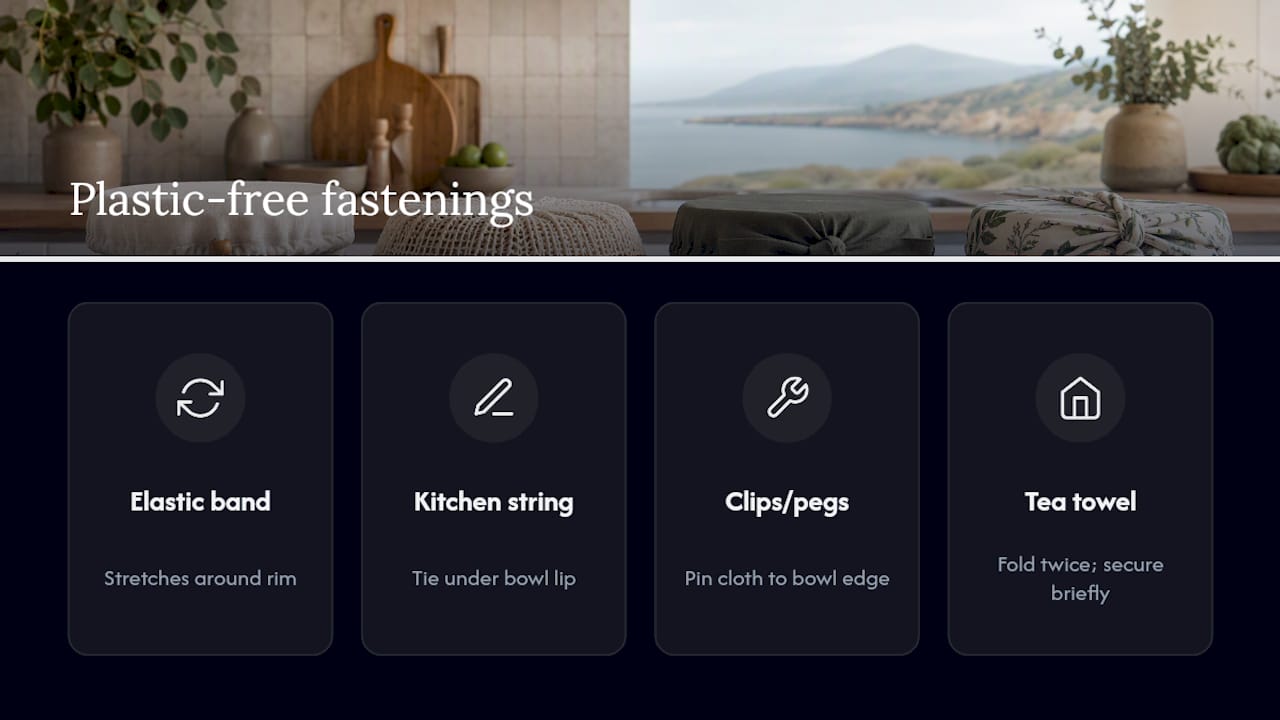
An elastic band stretched around the rim of a plate or fabric cover is the simplest fix, and it’s likely already in a kitchen drawer. For fabric covers without built-in elastic, a length of kitchen string tied firmly under the bowl’s lip works just as well and costs nothing. Metal binder clips or spring clothes pegs can pin a folded tea towel or cloth napkin over a bowl’s edge, which is handy for irregularly shaped dishes that a standard round cover won’t fit.
If you’re repurposing a plain cotton tea towel as a cover, an organic cotton tea towel folded twice over a bowl and secured with a clip or elastic band does the job for short-term use, like resting bread dough on the bench for half an hour.
For pet owners, the same no-plastic thinking extends past the kitchen. A plastic-free puppy waste bag uses the same logic as a compostable bowl cover: something that does the job of a single-use plastic item without leaving the same footprint behind.
None of these fastening methods need buying anything new if you already own elastic, string, or clips. South Australia’s single-use plastics guidance points to exactly this kind of small, repeatable swap as the practical starting point for cutting reliance on cling film and other throwaway plastics.
Where can you buy plastic-free bowl covers in Australia?
For DIY, all you need is cotton fabric, elastic, and beeswax pellets, most of which are available from craft or haberdashery shops. For a ready-made option, The Zero Store stocks two products that solve most of the “what do I use instead of cling film” moments in an Australian kitchen.
Plastic-Free Resealable Food Storage Bags cover the same ground as silicone lids for smaller portions: sandwiches, snacks, chopped vegetables, or anything you’d otherwise stuff into a zip-lock bag. They’re built to be reused, cutting out the constant buy-and-bin cycle of single-use plastic bags.
Plastic-Free Cling Wrap fills the gap for odd-shaped bowls, half-cut fruit, or dishes where a stretch lid or fabric cover won’t quite fit. It behaves like conventional cling film at the bench but breaks down rather than sitting in landfill for centuries. Both product pages list full specifications, sizing, and care instructions if you want the details before buying. For more everyday swaps, three evidence-backed kitchen changes worth trying alongside a new bowl cover are worth a look too.
Fewer plastic wraps, one swap at a time
If you’ve read this far, you’ve already got more options than a roll of cling film sitting in the drawer. The Zero Store exists for the moments when a beeswax wrap or a spare tea towel won’t cut it, whether that’s a bowl of leftovers heading for the freezer or a lunch that needs to survive a warm bag until midday.
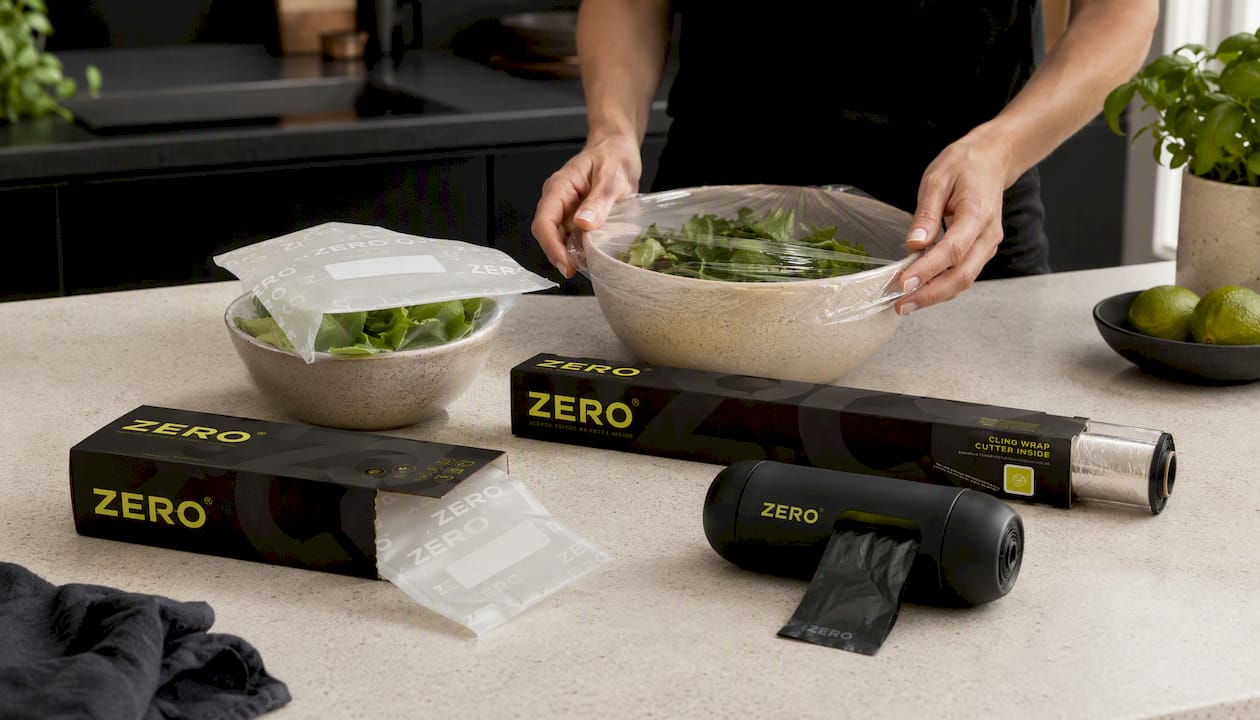
Plastic-Free Cling Wrap covers the odd-shaped bowls and half-cut produce that no lid or fabric square ever quite fits, and it’s made to break down instead of outliving everyone in the house. For portioned food and snacks, Plastic-Free Resealable Food Storage Bags replace the single-use zip-lock bags most Australian kitchens go through by the box. Both are made from bio-polymers rather than conventional plastic, so switching doesn’t mean giving up convenience to do the right thing.
Check the resealable bag range for sizing and pack options, and pick up a roll of cling wrap to keep on the bench for the jobs a lid can’t handle.
Sources
- Industrial Experts — silicone rubber food grade temperature range
- Environment
- Choice — plastics and food guidance
- Easy Things to Sew — reusable bowl cover pattern
FAQ
What can I use to cover a bowl instead of plastic?
Beeswax wraps, silicone stretch lids, fabric bowl covers, or simply a plate on top all work, depending on whether the food needs an airtight seal or just a dust cover.
Is there non-toxic cling wrap available?
Yes. Plastic-free cling wrap made from bio-polymers such as PLA and PBAT behaves like conventional cling film but is compostable and free of the microplastics and chemicals found in standard plastic wrap.
How do you cover food without plastic?
Match the cover to the food: silicone lids or lined fabric for anything wet or fridge-bound, unlined fabric for bread dough that needs airflow, and beeswax wraps for cheese, fruit, and sandwiches.
What can I use if I don’t have plastic wrap?
Reach for a plate, a bowl turned upside down, a folded tea towel secured with an elastic band, or a reusable resealable food storage bag if the food needs to be moved rather than just covered.
Are silicone lids safe for the freezer and microwave?
Food-grade silicone lids are rated from −60°C to 180°C, which covers freezer, fridge, microwave, and dishwasher use without issue.
Share:
Replace 50 Single Use Bags With Tare Produce Bags in Australia
Use Compostable Bags Within 6–12 Months: Shelf Life and Storage