Endocrine disruptors are chemicals that mimic, block, or otherwise interfere with your body’s hormones, and you cannot avoid them entirely. You can, though, meaningfully cut your exposure with a handful of targeted changes at home and at the shops. Low-dose exposure during pregnancy and infancy matters more than at almost any other life stage, because a developing body is far more sensitive to small hormonal shifts than an adult one.

Three actions do most of the work:

  • Cut back on plastics that touch food, especially anything reheated or acidic
  • Get on top of household dust, since it holds onto some of these chemicals for years
  • Read personal-care labels and skip vague terms like “fragrance” or “parfum” where you can

Key Takeaways

Reducing endocrine disruptor exposure works best as a short list of high-impact habits rather than an attempt at total avoidance.

Point Details
Focus on food-contact plastics first Heat and fat speed up chemical migration, making kitchen swaps the highest-return change you can make.
Prioritise pregnancy and infancy Placental and breast milk transfer make these life stages the most sensitive to low-dose exposure.
Tackle household dust Lipophilic chemicals like flame retardants accumulate in dust; wet-dusting and HEPA vacuuming measurably cut indoor levels.
Read personal-care labels Skip vague terms like “fragrance” or “parfum” to reduce undisclosed phthalate exposure.
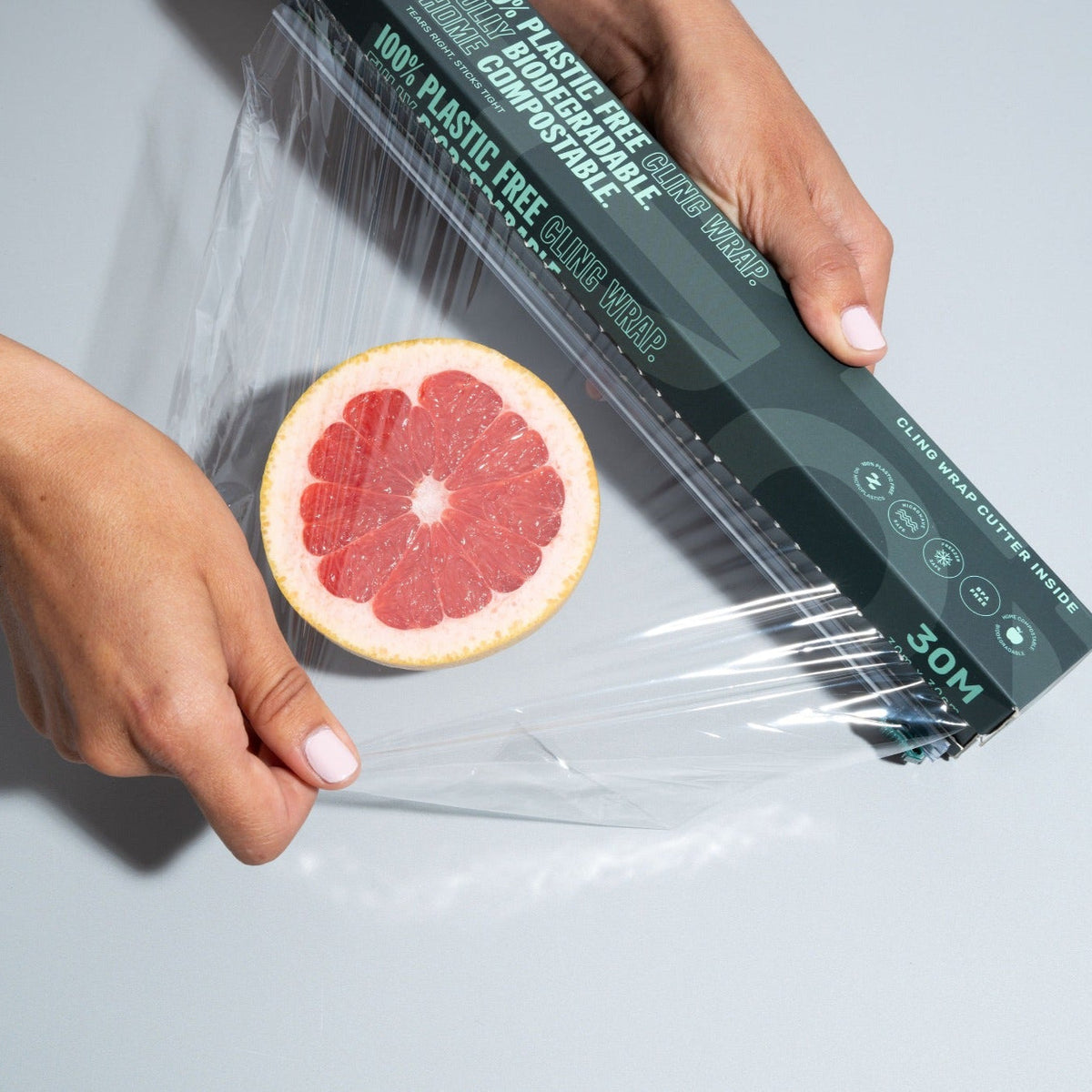
Choose biopolymer alternatives The Zero Store’s PLA and PBAT-based cling wrap, storage bags, and wipes offer a practical substitute for conventional food-contact plastics.

Primary sources and further reading

This article is general information, not a substitute for advice from a qualified doctor. Consult a qualified healthcare professional about your own circumstances before acting on anything here.

Table of Contents

What are endocrine disruptors and why does timing matter?

Endocrine disruptors, or EDCs, act on the hormone system in three main ways: they mimic a natural hormone closely enough to trigger a response, they block a hormone’s receptor so the real signal can’t get through, or they interfere with how the body produces, transports, or breaks hormones down. The Endocrine Society describes them plainly as exogenous chemicals that interfere with any aspect of hormone action.

Here’s the part that surprises most people: the dose that matters isn’t always the biggest one. Hormones themselves operate at tiny concentrations, so a small disruption at the wrong moment in development can cascade into effects that a much larger dose wouldn’t cause in an adult. This is why pregnancy, infancy and early childhood draw so much research attention.

The clearest historical proof of this is diethylstilbestrol, or DES, a synthetic oestrogen prescribed to pregnant women from the 1940s to the 1970s to prevent miscarriage. Decades later, daughters exposed in the womb showed elevated rates of a rare vaginal cancer and reproductive tract abnormalities. Nobody predicted it from short-term studies. It took a generation to surface, and it remains the textbook case for why life-stage timing outweighs dose in this field.

Which chemicals count as endocrine disruptors, and where do they hide?

Most households are dealing with the same handful of chemical families, just under different names on different products. A detailed review in the Endotext medical reference catalogues the major classes and their sheer reach across everyday goods.

  • BPA: found in the lining of canned food, some hard plastics and receipt paper. “BPA-free” doesn’t mean chemical-free. Many substitutes, like BPS, are structurally similar and may act on hormones in comparable ways.
  • Phthalates: used to make plastics flexible and to carry fragrance in personal-care products, vinyl flooring and some food packaging.
  • PFAS: the “forever chemicals” in non-stick cookware coatings, stain-resistant textiles, some fast-food wrappers and firefighting foam runoff, as detailed in PFAS pollution - What you need to know | LaTerraTales.
  • PBDEs and PCBs: legacy flame retardants and industrial compounds, still present in older furniture foam, electronics and building materials.
  • Pesticides: organophosphates and related compounds that persist as residue on produce and in agricultural regions.
  • Phytoestrogens: naturally occurring plant compounds, found in soy and flaxseed, that weakly mimic oestrogen. Worth knowing about, but a different risk category to industrial chemicals.

What health effects are linked to endocrine disruptor exposure?

The evidence splits cleanly into two tiers: well-established associations and emerging signals still being tested. Reproductive outcomes sit in the stronger tier. Studies have tied EDC exposure to reduced sperm quality, earlier onset of puberty in girls, fertility difficulties, and endometriosis, and peer-reviewed research continues to build on that link.

Diagram of health effects linked to endocrine disruptors

Metabolic effects come next. Researchers have connected some EDCs to weight gain and disrupted insulin signalling, with certain studies also flagging associations with specific cancers, though causation here is harder to pin down than for reproductive outcomes.

Neurodevelopmental and immune findings are newer and more contested. Some cohort studies link prenatal EDC exposure to ADHD-like behaviours in children, and specific PFAS exposures have been associated with a weaker antibody response to vaccines.

Why is causation so hard to prove here? Humans are exposed to dozens of these chemicals simultaneously, at low doses, over decades, which makes isolating any single culprit in a cohort study genuinely difficult. Animal studies can control for that, but translating rodent dosing to human relevance is its own challenge. The honest summary is a coherent, growing body of associations, not a settled list of proven causes.

How do endocrine disruptors get into your body?

Ingestion is usually the biggest route. Chemicals leach from food packaging and cookware into whatever you’re eating, especially when it’s hot, fatty, or acidic. Dermal absorption follows close behind: lotions, sunscreens, and fragranced products sit directly on skin, and some ingredients pass through it.

Inhaling and swallowing contaminated dust is the exposure route most people never think about. Many EDCs, including flame retardants, are lipophilic, meaning they cling to fat and dust rather than breaking down quickly, and household dust becomes a long-term reservoir for them. Reviews of household dust exposure show that regular cleaning measurably lowers indoor levels.

Maternal transfer deserves its own mention: EDCs cross the placenta and appear in breast milk, which is exactly why reduction efforts pay off most for anyone pregnant or nursing.

Pro Tip: Wet-dust surfaces rather than dry-dusting. Dry dusting just redistributes fine particles into the air where you’ll inhale them; a damp cloth actually captures them.

What are the most effective ways to reduce exposure at home?

Not every change matters equally. Some cut exposure meaningfully; others are mostly reassurance. Here’s a rough order of priority, starting with the food and kitchen changes that touch the most exposure routes at once.

  1. Swap plastic containers for glass, stainless steel, or a certified biopolymer alternative for anything you microwave, reheat, or store acidic food in.
  2. Avoid reheating food in plastic altogether. Heat accelerates chemical migration from packaging into food.
  3. Choose stainless steel or cast iron over non-stick cookware where the recipe allows it, since older non-stick coatings are a known PFAS source.
  4. Wet-dust hard surfaces weekly and run a HEPA vacuum on carpets and soft furnishings.
  5. Take shoes off at the door and wash textiles regularly. Both cut down on dust-bound chemicals tracked in from outside.

For personal care and cleaning products, the fix is simpler than it sounds: check the label before checking the price. Fragrance-free products, or ones that list every ingredient rather than hiding behind “parfum” or “fragrance,” are far less likely to contain undisclosed phthalates. When furnishing a home, ventilate new furniture for a few days before heavy use and look for pieces without added flame retardants where possible.

Some practical swaps worth having on hand:

  • A Plastic-Free Cling Wrap for covering food instead of conventional plastic film
  • Resealable Food Storage Bags for leftovers and packed lunches
  • Reusable Cleaning Cloths instead of rayon-based disposable wipes that shed synthetic fibres into dust
  • Cleaning Wipes with transparent ingredient lists for quick jobs
  • Baby Wipes free from added fragrance for households with infants
  • Plastic Free Produce Bags for fruit and vegetables that otherwise pick up residue from conventional plastic bags

If you’re pregnant, nursing, or raising a toddler, start here before anywhere else in the house. That’s where the developmental stakes are highest and where the evidence for prioritised reduction is strongest.

How The Zero Store’s product range supports lower-exposure households

Conventional PVC and polycarbonate plastics rely on additives, plasticisers, and coatings that sit in the same chemical families flagged throughout this article. Certified biopolymers such as PLA, PHA, and PBAT are built from different feedstocks and don’t need the same additive packages, which gives households a genuine substitution option rather than just a different brand of the same material.

The Zero Store’s catalogue includes:

How do scientists actually measure endocrine disruptors?

Detecting these chemicals sounds straightforward. It isn’t. Blood and urine tests can pick up certain EDCs, but many break down quickly in the body, so a single sample only captures a narrow window of recent exposure, not a lifetime pattern. Researchers increasingly rely on repeated sampling or biomarkers that persist longer, such as certain PFAS compounds that stay in blood for years.

Environmental testing has its own hurdles. Dust, water, and soil samples need sensitive laboratory equipment, typically mass spectrometry, to detect chemicals present at parts-per-billion or lower. Mixtures complicate everything further: real-world samples rarely contain just one EDC in isolation, and no standard test captures how a dozen chemicals interact at once inside a human body.

There’s also a mismatch between traditional toxicology and how EDCs actually behave. Classic testing assumes higher doses cause bigger effects. Endocrine disruptors sometimes break that rule entirely, producing measurable effects at very low doses that don’t scale predictably at higher ones, a pattern toxicologists call non-monotonic dose response. It’s one reason the Endotext review stresses that detection science still lags behind the chemicals it’s trying to track, and it’s a major reason regulatory testing frameworks remain a work in progress rather than a finished system.

How are endocrine disruptors regulated around the world?

Regulation of EDCs varies enormously by country, and no jurisdiction claims to have solved it. The European Commission has developed formal scientific criteria for identifying substances as endocrine disruptors under its chemicals and pesticides legislation, which is one of the more structured approaches globally. Even there, testing coverage remains incomplete, since thousands of chemicals in commercial use have never been assessed against the criteria.

Australia’s approach runs through several bodies rather than one dedicated EDC framework: the Australian Pesticides and Veterinary Medicines Authority assesses agricultural chemical risk, and the Australian Industrial Chemicals Introduction Scheme governs new industrial substances. Food-contact materials fall under Food Standards Australia New Zealand. This is a patchwork rather than an EDC-specific regime, which mirrors the situation in most countries outside the EU.

The practical gap for consumers is this: a chemical being legal doesn’t mean it’s been specifically tested for hormone activity, only that it hasn’t triggered whatever narrower safety threshold applies to its category. That’s a meaningful distinction, and it’s the main argument for treating personal risk reduction as a parallel track to regulation, not a replacement for waiting on it.

What don’t scientists know yet about endocrine disruptors?

The biggest gap is long-term, low-dose exposure over a full lifetime, which is almost impossible to study cleanly. Most research looks at single chemicals in isolation or short exposure windows, while real households encounter dozens of EDCs simultaneously, day after day, for decades.

Mixture effects are the emerging frontier. Two chemicals that each seem harmless at low individual doses can sometimes produce a bigger combined effect than either would alone, an area researchers call cumulative or “cocktail” risk. Testing frameworks built around single substances weren’t designed for this, and building ones that are is proving slow and expensive.

Epigenetic transmission is another active research thread: whether EDC exposure in one generation can alter gene expression patterns passed to the next, even without a direct exposure repeat. Early animal studies suggest it’s plausible; human confirmation is much further behind.

Newer chemical classes are also outpacing safety data. Regrettable substitution, replacing a banned chemical with a close chemical cousin that hasn’t been properly tested, keeps happening faster than research can catch up, which is exactly the story behind several BPA replacement compounds.

How do endocrine disruptors affect wildlife and ecosystems?

Wildlife gave scientists some of the earliest warning signs about EDCs, long before human health research caught up. Fish downstream of wastewater treatment plants have shown feminised traits from oestrogen-mimicking compounds in the water. Amphibians are particularly sensitive indicators, since their skin absorbs waterborne chemicals directly and their reproductive development is hormone-dependent at every stage.

Frog on wetland leaf near polluted water

Bird populations exposed to certain organochlorine pesticides historically showed eggshell thinning and reproductive failure, a pattern that helped drive early pesticide bans decades ago. Similar dynamics play out today with newer chemical classes moving through waterways from agricultural runoff and treated wastewater.

These aren’t just isolated environmental curiosities. Ecosystems act as an early warning system, and a chemical disrupting frog reproduction in a wetland is often a signal worth taking seriously for human exposure risk too, since the same compounds frequently end up in drinking water sources and the food chain.

Editorial perspective: what actually moves the needle at home

Most advice on this topic treats every source of exposure as equally urgent, and that’s where I think the conventional wisdom gets it wrong. Trying to eliminate every plastic, every fragrance, every dust particle at once is exhausting, expensive, and not what the evidence actually supports as necessary. The research points somewhere more useful: a short list of high-impact changes, done consistently, beats a scattergun approach to everything at once.

Food-contact plastics and household dust deserve the first attention, not personal-care products, however satisfying it feels to overhaul the bathroom cabinet. Heat and fat drive chemical migration from packaging faster than skin absorption from a moisturiser does, and dust is the exposure route people forget entirely.

If your household includes pregnancy, an infant, or a toddler who puts everything in their mouth, that’s where the return on effort is highest. Everyone else can make the same changes at a more relaxed pace, choosing better materials as things wear out rather than replacing a functioning kitchen overnight. Progress over purity, every time.

— Damien

Where to start if you want to reduce your household’s exposure

The Zero Store exists for exactly the gap this article keeps pointing at: the everyday plastic touching your food, your bathroom, and your bin, made from bio-polymers like PLA and PBAT instead of conventional PVC or polycarbonate. Rather than asking you to research every ingredient label from scratch, the range gives you pre-vetted swaps for the highest-impact categories covered above.

The Zero Store

The Plastic-Free Cling Wrap and Resealable Food Storage Bags cover the food-contact swaps that matter most, while Baby Wipes and Reusable Cleaning Cloths handle the household and infant categories where prioritisation counts. If dust control and cleaning are your next step, the Cleaning Wipes range offers a transparent-ingredient option without the rayon fibres found in many disposable cloths. Browse the full Resealable Bags range and pick your first swap today.

Sources

Latest Stories

This section doesn’t currently include any content. Add content to this section using the sidebar.