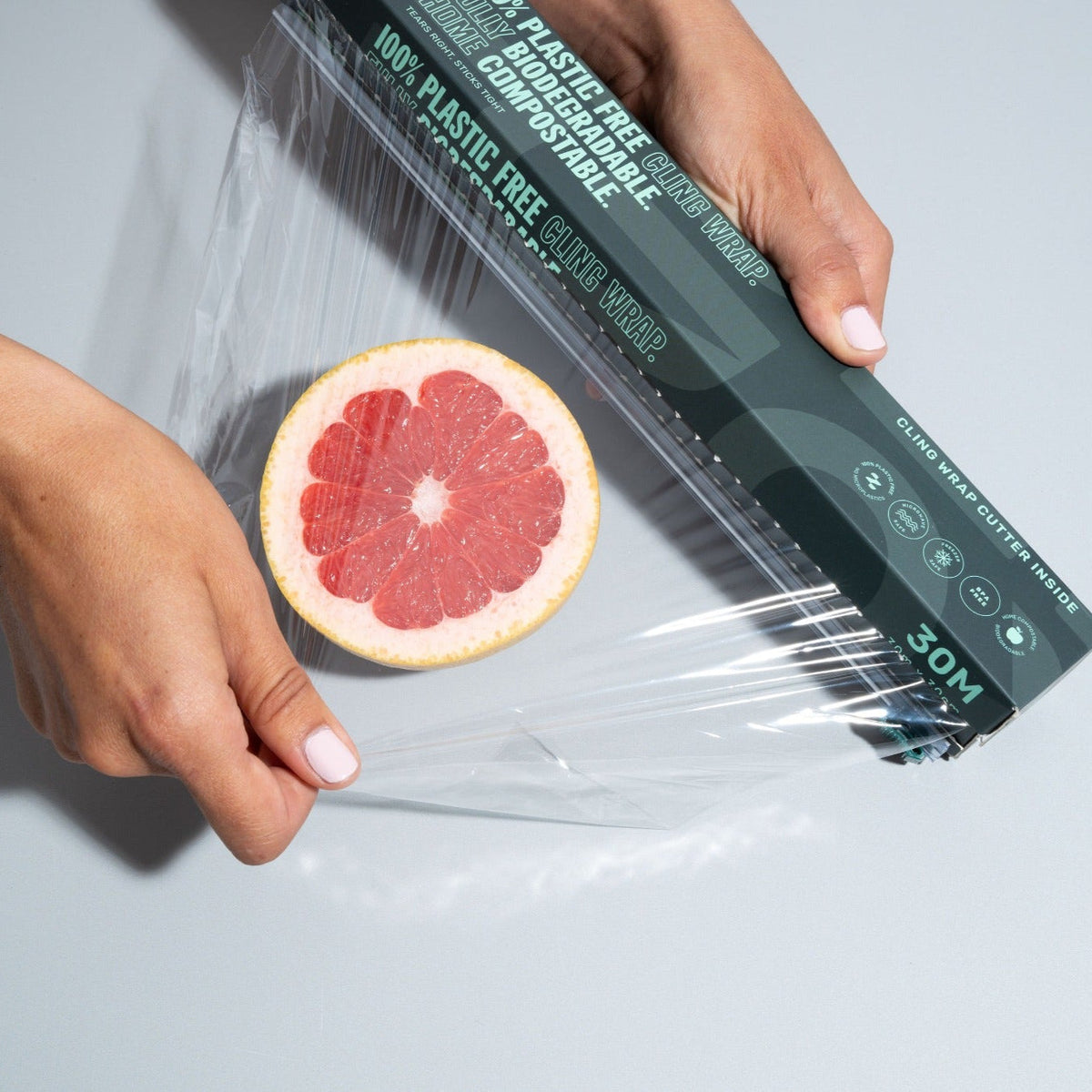
Cling film is not oven-safe unless the manufacturer explicitly states it is and prints a maximum temperature on the packaging. The Food Safety Authority of Ireland puts it plainly: cling film should not be used in an oven because it can melt and contaminate food. That guidance applies whether you are using a standard roll from the supermarket or a premium brand.

Before you reach for the cling film next time you are about to slide something into the oven, keep these points in mind:

  • Melting is likely. Most household cling film begins to soften well below typical baking temperatures.
  • Contamination is real. Melted film can transfer plasticisers and additives directly into food.
  • Fire risk exists. Film that contacts a heating element or the oven floor can ignite.
  • Microwave-safe is not oven-safe. These are two entirely different ratings, and confusing them is the most common mistake home cooks make.

Temperature to know: Many household wraps begin to deform around 100–120 °C, while a standard home oven set to 180 °C for a roast is already well past that point.


Key takeaways

Standard household cling film is not oven-safe, and no label short of an explicit “oven safe” claim with a temperature limit should be treated as permission to use it in a conventional oven.

Point Details
Default answer is no Do not use cling film in a conventional oven unless the packaging explicitly states oven-safe with a °C limit.
Microwave-safe ≠ oven-safe These are separate ratings; a microwave-safe label gives no information about dry oven heat tolerance.
Check three things on the label Look for the words “oven safe,” a maximum temperature in °C, and a list of approved appliances.
Use proven alternatives Aluminium foil, baking paper, oven bags, and lidded ovenproof dishes are all designed for oven temperatures.
The Zero Store’s plastic-free cling wrap A compostable, microplastic-free storage alternative — designed for the fridge and microwave, not the oven.

Table of Contents

Is cling film oven safe? What actually happens when you heat it

The short answer is that most cling film is not built for oven heat, and the chemistry explains why.

What cling film is made from

Household cling film is produced from one of several plastic polymers, each with its own heat tolerance:

Material Typical softening point Approximate melt/deform range Common use
PVC (polyvinyl chloride) ~70–80 °C ~100–120 °C Older and commercial wraps
LDPE (low-density polyethylene) ~85–90 °C ~110–130 °C Many modern household wraps
PVDC (polyvinylidene chloride) ~100–110 °C ~120–140 °C Some barrier wraps
PLA (polylactic acid) ~55–65 °C ~80–100 °C Biodegradable/compostable wraps

Diagram comparing cling film types and heat tolerance

Values are approximate and vary by formulation and brand. Source: KitchPrep.

Notice that PLA, the bio-polymer used in compostable wraps, has the lowest heat tolerance of the group. A biodegradable cling film is a better choice for the planet, but it is not a better choice for the oven.

Chemical migration and why it matters

When film softens under heat, the plasticisers and additives that give it flexibility can migrate into whatever food it is touching. This is the contamination risk that food safety authorities flag. The concern is not just about the film melting visibly; even partial softening at lower temperatures can allow chemical transfer into food. Exposure to sustained dry heat, as opposed to the moist, lower-energy environment of a microwave, accelerates that process.

Microwave-safe labelling means the film has been tested for the short, moist heat cycles a microwave produces. It says nothing about dry radiant heat at 160–220 °C. The two conditions are so different that manufacturers and food safety experts treat them as separate categories.

Practical risks at a glance

  • Film sagging onto food leaves a sticky, plastic-tasting residue that cannot be removed.
  • Film dripping onto the oven floor or a heating element can smoke heavily and, in some cases, catch fire.
  • Melted plastic on oven surfaces is difficult to clean and can affect subsequent cooking.
  • Unpleasant odours from burning film can linger in the oven for several cooking sessions.

Pro Tip: If you have accidentally melted cling film in your oven, let the oven cool completely, then remove as much solid residue as possible before running a low-temperature cycle with the door ajar to clear fumes. Do not cook food in the oven until the residue is fully removed.


How to tell whether your cling film is oven-safe

The only reliable test is the packaging itself, and you need to know exactly what to look for.

What the label must say

Vague phrases do not count. “Suitable for reheating” without a temperature limit means nothing useful. “Heat resistant” is equally ambiguous. The label needs to state one of the following clearly:

  • “Oven safe” as a specific claim, not a general descriptor.
  • A maximum temperature in °C (for example, “safe up to 220 °C”).
  • A list of approved appliances that includes “conventional oven” or “fan oven.”

If any of those three elements is missing, treat the film as unsuitable for oven use.

Packaging checklist

  • [ ] Does the label say “oven safe” explicitly?
  • [ ] Is there a maximum temperature printed in °C?
  • [ ] Does the appliance list include a conventional or fan oven (not just microwave)?
  • [ ] Does it specify whether the film may contact food directly, or must it be kept away from the food surface?
  • [ ] Are there any warnings about broiler, grill, or air fryer use?

The Food Safety Authority of Ireland confirms that manufacturer instructions are the authoritative test. If the box does not state oven-safe with a temperature range, the product is not suitable for oven use, full stop.

Pro Tip: If the packaging is gone, search the manufacturer’s website for the product’s technical datasheet or FAQ. Most major brands publish heat ratings online. If you cannot find the information, contact the manufacturer directly before using the film near heat.


When is it safe to use cling film near heat?

There is a narrow set of circumstances where cling film is genuinely safe around heat, and a longer list of situations where it is not.

Safe uses

  • Microwave reheating, when the film is labelled microwave-safe. Keep it loose so steam can escape, and never let it touch the food surface if the label advises against contact.
  • Covering food after cooking to retain warmth for a short period at room temperature. No heat source involved.
  • Low-temperature oven warming only when the film is explicitly rated for that temperature, the film is shielded from direct heat, and the manufacturer’s instructions permit it.

Clear don’ts

  • Never place cling film on an exposed oven rack where it can contact the metal directly.
  • Never use cling film under a grill or broiler, or in an air fryer. The concentrated radiant heat in both appliances far exceeds what any household film can tolerate.
  • Never allow film to hang near a heating element, even if it is not directly touching it.
  • Never assume that because a recipe online suggests wrapping in film before foiling, your specific film is safe for that method.

Even in professional kitchens, the film-under-foil technique is a specialist approach. It is not a general recommendation for home cooks, and the next section explains why.


What to use instead when cooking in the oven

Cling film has no place in a hot oven, but several alternatives do the job better.

Plastic-Free Cling Wrap

Temperature limits are approximate and vary by product. Always check the manufacturer’s label.

Choosing the right cover

  • Moisture retention matters most? Use an oven bag or a lidded dish. Both trap steam effectively without any risk of melting.
  • Browning or crisping is the goal? Remove the foil or lid for the final 15–20 minutes. Cling film could never do this job anyway.
  • Eco-conscious cooking? Silicone covers are reusable and rated for oven temperatures. They are a practical long-term swap for single-use foil.

Household wraps, including plastic-free and biodegradable cling wraps, are designed for cold storage and brief microwave reheating, not sustained oven heat. The Zero Store’s plastic-free cling wrap and resealable food storage bags are storage solutions. Unless a specific product is explicitly listed as oven-safe on its packaging, do not use it in the oven.


Why chefs use film in the oven and why you probably should not

Some professional kitchens do use plastic film in the oven. The technique involves wrapping food tightly in film, then covering it completely with heavy aluminium foil. The foil reflects radiant heat so the film is mainly exposed to steam rather than dry oven heat. It works as a moisture-control method for certain preparations.

The risks when home cooks attempt the same approach are significant:

  • Most home cooks do not know the exact formulation of their household film, so the heat tolerance is unknown.
  • Domestic ovens have hot spots that professional combi ovens do not, meaning the film may be exposed to higher temperatures than expected.
  • If the foil is not sealed tightly, radiant heat reaches the film directly.
  • Contact with any part of the oven’s heating element, even briefly, can cause the film to ignite.

Robert L. Wolke and food safety experts cited by Simply Recipes note that the double-layer technique works only when the film’s formulation, the foil shield, and the oven temperature are precisely controlled. That level of control is routine in a professional kitchen and largely absent in a home one. The foil is a heat shield, not a licence to use standard household film at normal baking temperatures.

The broader point from Treehugger’s analysis is worth keeping in mind: some wraps may resist higher temperatures in practice, and foil does reduce radiant heat exposure, but microwave-safe labelling is not the same as oven-safe, and relying on informal hacks is risky. Unless you have the exact product specifications in front of you and the manufacturer confirms oven use, replicate the professional technique at your own risk.


An honest take on kitchen safety and sustainable choices

The question of whether cling film is oven-safe comes up constantly, and the answer has not changed: for the vast majority of home cooks using standard supermarket rolls, the answer is no. What surprises me is how often the professional kitchen exception gets cited as a reason to try it at home. Those two contexts are not comparable. A chef using a known commercial film grade in a controlled combi oven at a precise temperature is doing something categorically different from a home cook wrapping a casserole in whatever roll is in the drawer.

The sustainability angle adds another layer. Switching to biodegradable or plastic-free cling film is genuinely better for the environment. But it does not make the film oven-safe. PLA-based wraps, in fact, soften at lower temperatures than conventional LDPE. The right move is to use plastic-free film for what it is designed for, which is cold storage and short microwave use, and reach for foil, parchment, or a lidded dish when the oven is involved.


Plastic-free storage that does the job it is designed for

If this article has you rethinking your kitchen plastic use more broadly, The Zero Store offers a practical starting point. The plastic-free cling wrap is made from bio-polymers including PLA and PBAT, contains no microplastics, and is home-compostable. It is designed for food storage, wrapping leftovers, and covering bowls in the fridge or for short microwave use when labelled accordingly.

Plastic-Free Cling Wrap

To be clear: these are storage products. They are not oven substitutes unless a specific item explicitly states otherwise on its packaging. The Zero Store’s position is straightforward: use the right tool for the job. Plastic-free cling wrap replaces conventional plastic film for storage and reduces your household’s microplastic load. For the oven, use foil, parchment, or a lidded dish. Browse the plastic-free range to find the storage solution that fits your kitchen.


Sources

For product-specific temperature ratings, contact the manufacturer directly or search for the product’s technical datasheet on the brand’s website. If that information is not publicly available, treat the film as unsuitable for any oven use.

Latest Stories

This section doesn’t currently include any content. Add content to this section using the sidebar.