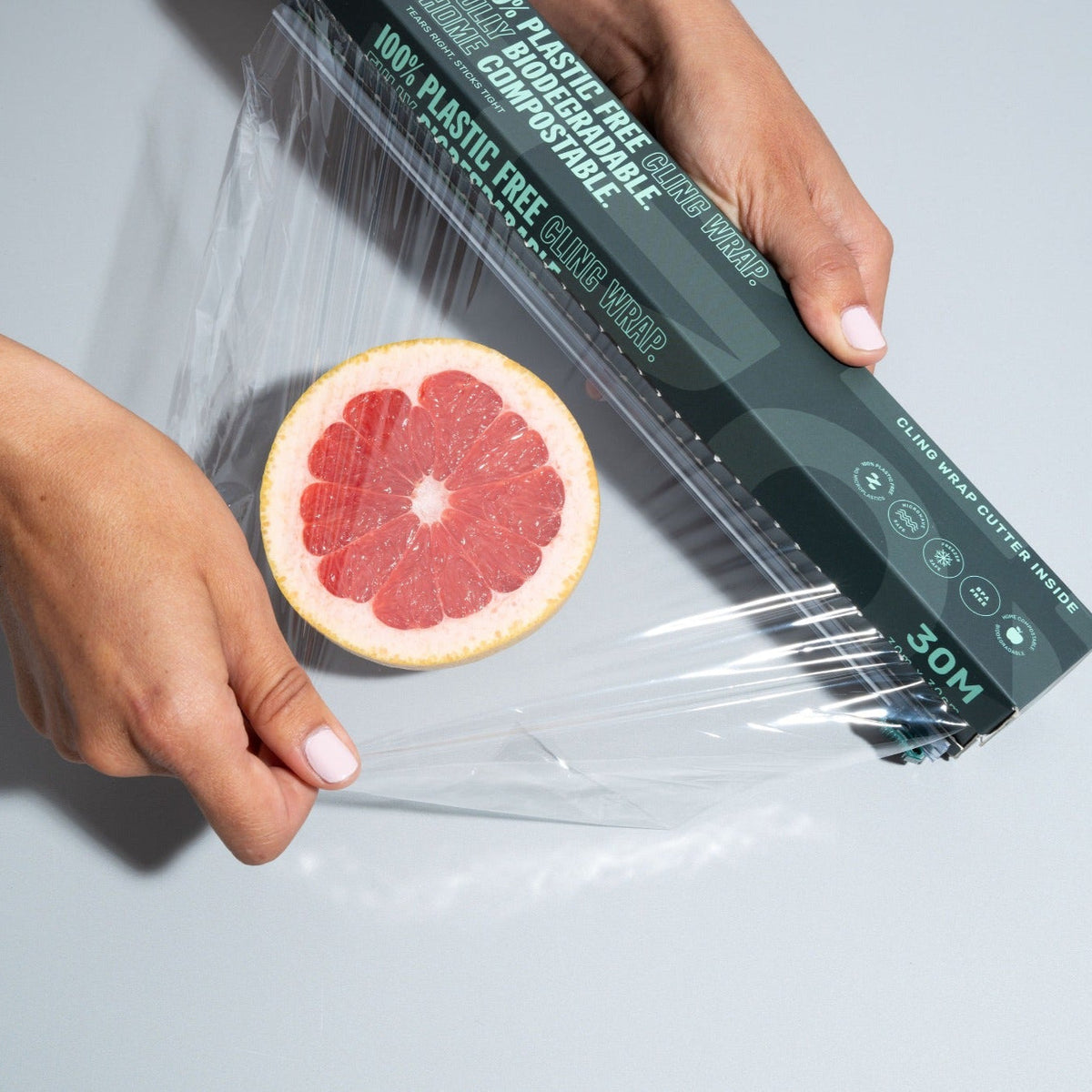
Short answer: standard PLA cling film and resealable bags soften between roughly 50°C and 65°C, so you shouldn’t assume they’re safe for microwaving, dishwashers, or hot-fill unless the product explicitly says so. That range covers the glass transition temperature (Tg) and heat deflection point of unmodified PLA, the biodegradable polymer used in most compostable cling wrap and food storage bags. Some manufacturers modify PLA to raise that ceiling, but you only know this from the label, not the material name.

Here’s what to check before you reach for the microwave or dishwasher:

  • Look for an explicit “microwave-safe” claim backed by a tested temperature or power/time limit.
  • Check the product page or technical data sheet for a Vicat softening temperature (VST) or heat deflection temperature (HDT) figure.
  • Confirm compostability certification (AS 4736 for commercial composting, AS 5810 for home composting) separately, since it says nothing about heat tolerance.
  • When in doubt, reheat in glass or polypropylene and save PLA film for chilled or room-temperature food.

Pro Tip: If a product page only mentions compostability and says nothing about temperature, treat it as not rated for heat. Silence on the spec sheet is not a safety claim.

Key Takeaways

Standard PLA softens between roughly 50°C and 65°C, so heat safety depends on the specific product’s tested rating, not the fact that it’s labelled PLA.

Point Details
Check the softening range Standard PLA softens around 50 to 65°C, close to common microwave and dishwasher temperatures.
Microwave only with proof Only microwave PLA film or bags if the label states a tested microwave-safe rating.
Skip the dishwasher Hand wash PLA bags in cool or warm water rather than running them through a hot dishwasher cycle.
Cold storage is safe Fridge and freezer use poses no heat risk to PLA, unlike warming or reheating.
Compostable isn’t heat-proof AS 4736 and AS 5810 certification describe end-of-life breakdown, not temperature tolerance.
Buy with data, not guesswork The Zero Store lists technical specs on its cling wrap and resealable bag pages so you can check ratings before you buy.

Table of Contents

What is PLA heat resistance and why does it vary so much?

PLA heat resistance comes down to two numbers most shoppers never see: glass transition temperature (Tg) and heat deflection temperature (HDT). Below Tg, the polymer chains sit rigid and the film holds its shape. Above it, those chains gain enough mobility to soften, stretch, and lose their seal. For standard PLA, that shift happens between roughly 50°C and 65°C, which sits uncomfortably close to a cup of tea, let alone a microwave.

Diagram of PLA heat resistance temperature ranges

A manufacturer’s technical data sheet for a common PLA grade puts glass transition near typical mid-60s degrees Celsius and Vicat softening around similar values in the low 60s, right in the middle of the range cited above. That’s a useful reference point: it tells you the industry-standard figures aren’t a rough guess, they’re measured and repeated across multiple sources.

What that means for your kitchen:

  • A wrap left touching a hot pan handle or resting on a just-boiled pot can locally exceed its softening point even if the surrounding air feels only warm.
  • Steam concentrates heat against a thin film far more aggressively than dry air at the same nominal temperature.
  • Thinner PLA films (the kind used for everyday cling wrap) soften faster than thicker moulded PLA items, because there’s less mass to absorb heat before the surface gives way.

None of this means PLA is a poor material. It means the number on the pack matters more than the name of the polymer.

Can you microwave PLA cling film or bags?

Avoid microwaving PLA cling film or resealable bags unless the packaging or technical data sheet states a tested microwave-safe rating. That’s the safe default, and it holds for most products currently on Australian shelves, because standard PLA’s softening range overlaps with the temperatures food reaches in a microwave within seconds.

A few practical rules keep you out of trouble:

  • Never let PLA film touch or cover boiling liquids or steaming food. Steam contact is the fastest way to exceed the softening point.
  • Don’t use PLA bags for high-power or long-duration reheating. A quick 20-second warm on low power is a different risk profile to five minutes on high.
  • If a product does carry a microwave-safe claim, test cautiously the first time and watch for warping, clouding, or a loose seal.
  • For anything you’d normally blast on full power, reach for glass, ceramic, or a microwave-safe polypropylene container instead.

Some engineered PLA blends genuinely do better here. Peer-reviewed testing on stereocomplex PLA blends found they held their shape through several minutes at 500 watts, particularly with low-moisture foods. That’s a real result, but it applies to a specific, tested formulation, not to “PLA” as a category.

Pro Tip: Low-water foods like bread or rice are lower risk than soups and sauces, because there’s less steam generated against the film’s surface.

Is PLA cling film dishwasher-safe?

Home dishwashers typically run hotter and steamier than PLA can handle, so avoid the dishwasher unless a product is expressly labelled dishwasher-safe. A standard cycle combines sustained heat with direct water and steam contact, which is close to the worst-case scenario for a polymer with a softening point around 60°C.

The risk isn’t dramatic melting. It’s quieter: seams weakening, seals loosening, or bags coming out slightly warped and harder to reseal properly next time.

For everyday cleaning, hand wash resealable PLA bags in cool or warm water and let them air dry. Treat single-use cling film as genuinely single-use rather than trying to rinse and reuse it. If you want something built for the dishwasher, choose a reusable item designed for that purpose, such as a reusable cleaning cloth.

Pro Tip: A bag that comes out of a hot wash slightly cloudy has usually crossed its softening point, even if it still looks intact.

Are PLA bags and cling film fridge and freezer safe?

Yes, PLA is safe for fridge and freezer storage. Cold temperatures don’t threaten the polymer the way heat does. There’s no equivalent “freezing point” risk for PLA the way there’s a softening point on the warm end.

The only real caution is moisture. High-water foods can create condensation against the film as they freeze and thaw, occasionally leaving bags soggier or less crisp than a conventional plastic equivalent. Check that the specific product declares freezer suitability if you’re storing something for the long term.

  • Let hot-cooked food cool to room temperature before wrapping it in PLA film.
  • Separate hot-filled containers from PLA-wrapped items until everything’s at a safe temperature.
  • Label frozen items, since PLA film can behave slightly differently to conventional wrap over long freezer storage.

How do manufacturers make PLA more heat resistant?

Some PLA products are engineered to handle far higher temperatures than standard film, but that improvement has to show up as tested data, not just a claim. Manufacturers raise PLA’s heat tolerance through a handful of established techniques, and knowing the names helps you spot genuine engineering versus marketing gloss.

  • Annealing heats the polymer to encourage crystal formation, which restricts the chain movement that causes softening.
  • Nucleating agents are additives that speed up and increase that crystallisation during moulding.
  • Stereocomplexation blends two mirror-image forms of PLA, creating a stronger internal structure that resists heat better than either form alone.
  • Blending combines PLA with other biopolymers to shift its thermal behaviour, sometimes trading off other properties like flexibility.

The scale of the effect can be significant. Research on PLA modification has recorded heat deflection temperatures climbing past 100°C once crystallinity is pushed above roughly 35% through annealing, a dramatic jump from the standard 50–65°C range. That’s the difference between a film that survives a microwave and one that doesn’t.

The checklist for spotting real heat resistance:

  • A specific temperature limit, ideally in degrees, not a vague “heat resistant” claim.
  • VST or HDT figures on a technical data sheet.
  • An explicit “microwave-safe” or “dishwasher-safe” label, ideally with test conditions (power, time).
  • A stated food-contact compliance statement.
  • A compostability standard reference (AS 4736 or AS 5810) as a separate line item, not a substitute for the above.

What should you check before buying PLA cling film or bags?

Run through this before adding a PLA product to your cart, whether you’re shopping online or reading a label in-store:

  • Does the pack or product page state a temperature limit in degrees?
  • Is there a “microwave-safe” or “dishwasher-safe” claim, and does it come with test conditions?
  • Are VST or HDT figures listed anywhere, even in a linked technical data sheet?
  • Does the listing confirm food-contact compliance?
  • Is a compostability standard named (AS 4736 for commercial facilities, AS 5810 for home compost)?
  • Can you find or request a technical data sheet if none of this is on the pack?

If a seller can’t produce temperature data on request, that’s useful information in itself. A quick email or product-page enquiry asking for the VST/HDT figures or a tech sheet is a reasonable thing to expect from any manufacturer selling into the Australian market. And keep the two properties separate in your head: compostable tells you how the product breaks down at the end of its life, not how it behaves in a hot oven or dishwasher. They’re independent claims, tested independently.

Using and disposing of PLA products the right way

Cool hot food to below the product’s stated limit before wrapping it, and keep PLA well away from boiling water or hot oil, both of which will exceed the softening point almost instantly on contact.

At end of life, the AS 4736 and AS 5810 standards matter more than most shoppers realise. AS 4736 covers commercial compostability, meaning the product needs an industrial facility’s heat and processing time to break down fully. AS 5810 covers home compostability, meaning your backyard compost bin can handle it under normal conditions. A product certified only to AS 4736 won’t necessarily break down properly in a home bin, so check which standard applies before assuming your council green bin or backyard heap is the right destination.

A practical routine: use PLA film for chilled storage and short-term wrapping, keep glass or polypropylene on hand for anything that needs reheating, and check your local council’s guidance on commercial composting drop-off points if your product is only AS 4736 certified.

Using and disposing of PLA products the right way — overview diagram

Publisher perspective: how The Zero Store approaches PLA claims

We test the claims on the products we stock, not just the material name. Before a PLA cling film or resealable bag goes on our shelves, we ask suppliers for technical data sheets and prefer stock with stated temperature ratings and recognised compostability certification over generic “eco-friendly” wording. “PLA” alone tells you almost nothing about how a product will behave in your kitchen. What tells you something is a number, and we push for that number before we push a product to you.

Our product pages list the technical specs and FAQs we’d want to see ourselves if we were the ones buying, precisely because we think shoppers deserve the same information a materials engineer would ask for.

Where to find heat-tested PLA products

The Zero Store’s plastic-free cling wrap is designed for everyday food storage rather than reheating duty, and the product page sets out exactly what it’s rated for so you’re not left guessing at the point of purchase. That’s the practical advantage over generic PLA listings that lean on the word “compostable” and leave temperature data out entirely: you can check the number before you buy, not after something warps in the microwave.

The Zero Store

The same approach applies across the range. Our resealable food storage bags and plastic-free produce bags are built for fridge, freezer, and pantry use, with product pages that spell out what each bag handles and what it doesn’t. If you need something for hot washing rather than cold storage, our reusable cleaning cloths are the better fit, since they’re designed to survive repeated washing rather than a single use. Browse the full plastic wrap range to compare specifications side by side, and remember that safety always comes down to the individual product’s stated limits, not the material family it belongs to.

Frequently asked questions

Is PLA cling film safe for hot food? It depends on the temperature. PLA typically softens between 50°C and 65°C, so cooling food slightly before wrapping is safer than wrapping it straight off the stove.

Can you put PLA bags in the microwave? Only if the packaging explicitly states a tested microwave-safe rating. Without that label, treat PLA as unsuitable for microwave use.

Does compostable mean heat resistant? No. Compostability standards like AS 4736 and AS 5810 describe how a product breaks down at end of life, not how it performs under heat.

Why do some PLA products handle heat better than others? Manufacturing techniques such as annealing, stereocomplexation, and nucleating agents change the polymer’s internal structure and can raise its heat tolerance well above standard PLA.

Is PLA safe in the freezer? Yes. Cold storage doesn’t stress PLA the way heat does, though very high-moisture foods can leave condensation against the film during thawing.

Sources

  • Review strategies and techniques for improving heat resistance and mechanical performances of poly(lactic acid) (PLA) biodegradable materials

Latest Stories

This section doesn’t currently include any content. Add content to this section using the sidebar.