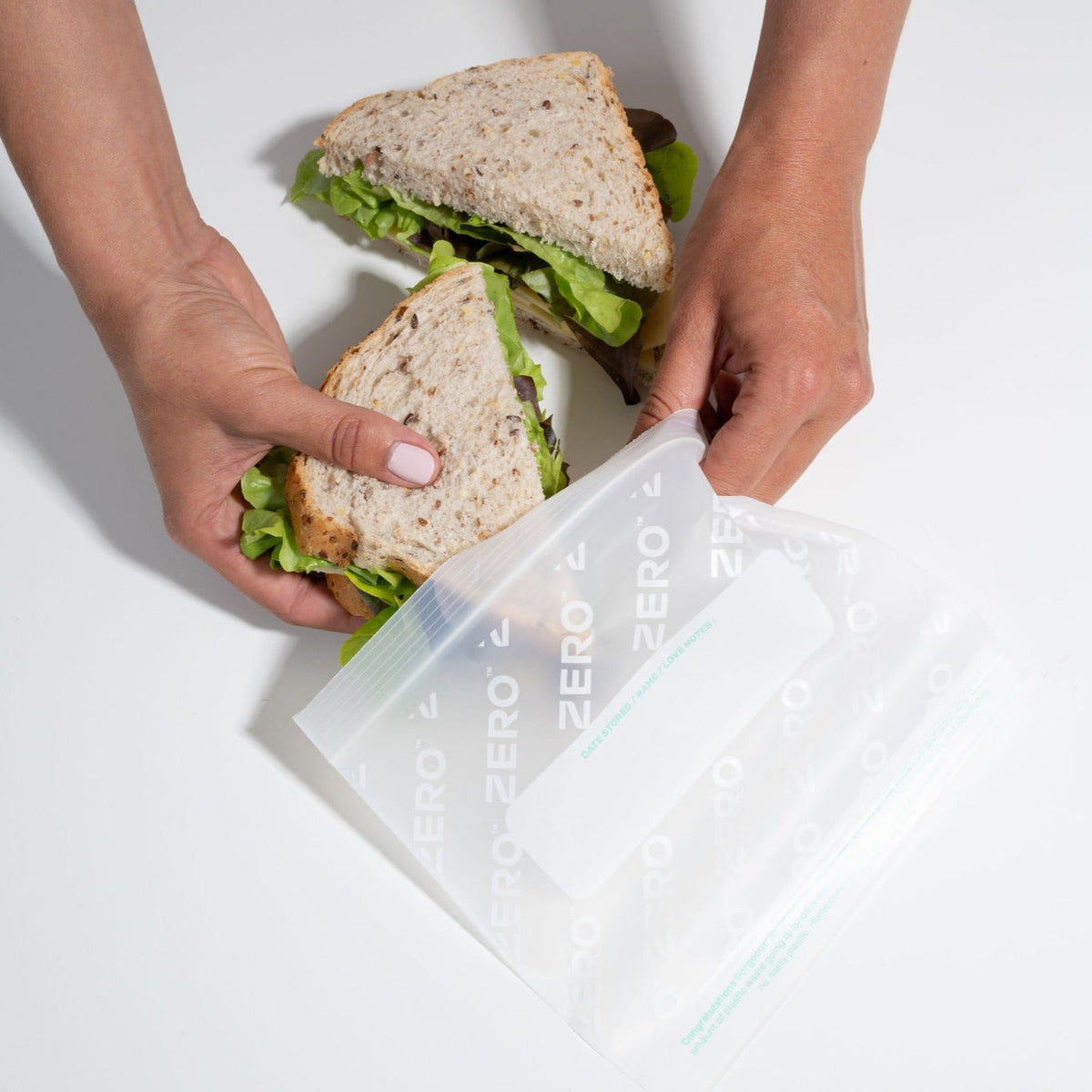
Certified compostable sandwich bags are worth buying for single-use situations, but only when you pick the right type and know how to dispose of them. The short version: choose a resealable bio-polymer bag (PLA/PBAT) with a recognised certification mark, and confirm whether your local council accepts food-waste or industrial composting collections before you buy.

At a glance — what to look for:

  • Certification: EN 13432, OK Compost HOME or OK Compost INDUSTRIAL, TÜV/Seedling logo
  • Composting environment: home compost (look for “OK Compost HOME”) vs. industrial facility (most PLA/PBAT blends)
  • Bag type: resealable zip/press-seal for packed lunches; uncoated paper for dry snacks
  • Storage: cool, dry place, away from sunlight; use within 12 months to maintain material integrity
  • Red flag: any bag labelled only “biodegradable” with no certifying body named

Table of Contents

What are compostable sandwich bags and what are they made from?

“Compostable” and “biodegradable” are not the same thing, and the difference matters the moment you need to throw the bag away. A biodegradable product will break down eventually, but with no defined timeframe and no guarantee it leaves anything useful behind. A compostable product must meet a specific standard, breaking down into water, CO₂, and biomass within a set period under defined conditions. That standard is what the certification marks on the packaging actually verify.

Common materials you will find:

  • Uncoated kraft paper: the simplest option. No plastic lining, no wax coating. Typically home-compostable and suitable for dry or lightly moist foods.
  • PLA (polylactic acid): a plant-derived bio-plastic, usually from maize starch. Clear, flexible, and good for resealable bags. Requires industrial composting in most formulations.
  • PBAT (polybutylene adipate terephthalate): a flexible bio-polymer often blended with PLA to improve tear resistance and seal strength. Also requires industrial composting.
  • PLA-windowed paper bags: kraft paper with a clear PLA window. The paper component may be home-compostable, but the PLA window usually needs an industrial facility — meaning the bag as a whole should go to industrial composting.

Bag types and where they fit:

  • Resealable zip/press-seal: best for packed lunches, moist foods, and anything you want to open and close. Most are PLA/PBAT blends.
  • Unlined paper greaseproof: good for sandwiches, pastries, and dry snacks. Lower barrier to moisture over time.
  • Windowed paper bags: useful for visibility, but check the disposal route for the PLA film separately.

Pro Tip: If you want one bag that handles most situations, a certified resealable PLA/PBAT bag gives you the best combination of seal integrity and food safety — just confirm it carries an industrial or home composting mark before buying.


Which certification marks can you actually trust?

The label on the front of the pack is only as useful as the standard behind it. Here is what the main marks mean for UK shoppers:

Certification Standard Composting environment Typical timeframe
EN 13432 European standard for packaging compostability Industrial Up to 12 weeks
OK Compost INDUSTRIAL TÜV Austria Industrial composting facility Certified to EN 13432
OK Compost HOME TÜV Austria Home compost heap Longer; lower temperature
TÜV/Seedling logo DIN CERTCO / European Bioplastics Industrial Meets EN 13432
BPI / ASTM US standard, sometimes seen on imported products Industrial 180 days in commercial facility

Infographic showing compostable bag certification types and composting environments

The marks that matter most for home composting are OK Compost HOME and equivalent home-compost certifications. EN 13432 and the Seedling logo only guarantee breakdown under industrial conditions — a backyard heap does not get hot enough or maintain the right moisture levels to meet those standards.

Misleading claims to watch out for:

  • “Biodegradable” with no standard cited
  • “Eco-friendly” or “green” with no certifying body named
  • “Plant-based” used as a proxy for compostable (it is not)
  • Vague “breaks down naturally” language with no timeframe

Pro Tip: Flip the pack over and look for the certifying body’s name alongside the logo — TÜV Austria, DIN CERTCO, or BPI. A logo without a named body is a marketing claim, not a verified standard.

Certified composting timeframe: PLA/PBAT blends certified to BPI/ASTM standards are typically designed to compost within 180 days in a commercial composting facility.


How do you compost these bags in the UK?

This is where most shoppers get caught out. The UK does not have a single national composting infrastructure — what your council accepts varies significantly by area.

Your disposal options, in plain terms:

  • Home compost bin: only for bags explicitly certified OK Compost HOME or equivalent. Do not put PLA/PBAT resealable bags in a home heap; they will not break down properly.
  • Council food-waste collections: some UK councils accept certified compostable packaging alongside food waste, but many do not. Check your local authority’s website directly — search “[your council] food waste what can I put in.”
  • Industrial composting drop-off: a small number of community composting sites and commercial food-waste operators accept certified compostable packaging. Your council’s waste pages or the WRAP (Waste and Resources Action Programme) website can point you to local options.
  • General waste as a last resort: if no composting route is available, general waste is preferable to contaminating the recycling stream. Compostable bags do not belong in the plastic recycling bin.

Municipal acceptance varies widely across UK regions, so checking before you buy is genuinely useful rather than optional.

Composting timeframe note: most certified PLA/PBAT bags require an industrial facility operating at controlled temperature and humidity. A standard garden compost heap will not replicate those conditions, and the bag may persist for years rather than months.

Pro Tip: Before switching to compostable bags, spend two minutes on your council’s website to confirm whether your food-waste bin accepts certified compostable packaging. If it does not, uncoated paper bags that are home-compostable may be a more practical choice for your household.


Hands adding compostable bag to kitchen compost bin

Honest pros and cons of compostable sandwich bags

Strengths:

  • Lower fossil-carbon footprint than conventional polyethylene bags when made from plant-based PLA/PBAT
  • No added PFAS in well-specified products — an important food-safety point given growing concern about per- and polyfluoroalkyl substances in food packaging
  • Certified breakdown under the right conditions, leaving no long-term plastic pollution
  • Resealable options are washable and reusable before composting, extending their useful life

Weaknesses:

  • Grease resistance is lower than some conventional plastics, particularly for paper-based options
  • Bio-polymers are sensitive to heat and moisture; store them incorrectly and they begin degrading before you use them
  • Shorter practical shelf life than conventional plastic bags — most guidance suggests using within 12 months of purchase
  • Higher unit cost than standard zip-lock bags
  • Seal integrity on cheaper products can be inconsistent, particularly after washing

Common performance issues and quick fixes:

  • Fogging or cloudiness: normal for PLA films; does not affect food safety
  • Seal weakening after washing: rinse gently, air-dry fully before resealing
  • Tearing at corners: PBAT-blended bags handle this better than pure PLA; check the material spec before buying

Pro Tip: For greasy foods like cheese or cured meats, look for a bag that specifically states grease resistance in its product description. Plain PLA film without a barrier layer will absorb oils over time.


Buying checklist: what to ask before you buy

Run through these before adding any bag to your basket:

  1. Does it carry a named certification (EN 13432, OK Compost HOME/INDUSTRIAL, BPI, TÜV/Seedling)?
  2. Does the packaging state whether it needs home or industrial composting?
  3. Is the material breakdown timeframe stated?
  4. Does it specify grease resistance, or is it only rated for dry foods?
  5. Is it resealable, and is the seal rated for washing and reuse?
  6. Is it freezer-safe (useful for batch cooking and meal prep)?
  7. Does it explicitly state “no added PFAS”?

Red flags — walk away if you see these:

  • “Biodegradable” with no standard or certifying body cited
  • No disposal instructions on the packaging at all
  • PFAS not mentioned in the product specification
  • Vague claims like “eco” or “green” with no supporting detail

For daily packed lunches, prioritise seal quality and grease resistance. For occasional travel or events, a simpler paper option may be sufficient and cheaper.

Pro Tip: Search the certifying body’s database directly — TÜV Austria’s OK Compost database and DIN CERTCO’s Seedling registry both let you verify whether a specific product is genuinely certified, not just using the logo without authorisation.


How to store compostable bags so they last

Bio-polymer films start degrading the moment they encounter heat, moisture, or UV light — which means storage matters more than it does for conventional plastic bags.

Storage rules that actually make a difference:

  • Keep bags in a cool, dry cupboard away from direct sunlight and away from the cooker or dishwasher
  • Do not store them in a damp garage or shed, particularly over winter
  • Use within 12 months of purchase; industry guidance consistently flags this as the practical window for most bio-polymer films
  • For resealable types, keep the closure track clean and dry between uses

Usage tips:

  • Allow hot food to cool completely before sealing — trapped steam weakens the seal and can prematurely degrade the film
  • Do not microwave food inside the bag unless the manufacturer explicitly states it is safe
  • For freezer use, check the product page; some PLA/PBAT blends are rated for freezing, others are not

Pro Tip: Buy in quantities you will use within a year. A bulk pack that sits in a warm kitchen cupboard for 18 months may have already begun to degrade before you open the first bag.


Hands retrieving compostable bag box from pantry shelf

When should you use compostable bags and when should you choose reusables?

Compostable bags sit in the middle of the sustainability hierarchy, not at the top. Reusable containers — silicone bags, glass boxes, stainless steel tins — are the better choice for anything you do regularly, because their environmental cost is spread across hundreds of uses. Sustainable packaging guidance consistently places reusables first and compostable single-use as a secondary option for situations where washing is genuinely impractical.

Where compostable bags make clear sense:

  • School or work lunches where the bag will not come home (or frequently gets lost)
  • One-off events, picnics, and travel where washing facilities are not available
  • Food service and catering situations where hygiene rules make reuse impractical
  • Situations where you need a disposable option but want to avoid conventional plastic ending up in landfill

Where reusables are the better call:

  • Daily packed lunches at home or in an office with a sink
  • Storing leftovers in the fridge or freezer regularly
  • Snacks for children who reliably bring containers home

The environmental comparison with conventional plastic is straightforward when disposal works correctly: a certified compostable bag that reaches an industrial facility produces no persistent plastic pollution. The caveat is that “when disposal works correctly” is doing a lot of work in that sentence. If the bag ends up in general waste because no composting route exists locally, the net benefit over conventional plastic narrows considerably.


Key takeaways

Certified compostable sandwich bags are a practical, lower-plastic choice for single-use situations, provided you check the certification mark and confirm your local disposal route before buying.

Point Details
Check the certification Look for EN 13432, OK Compost HOME/INDUSTRIAL, or TÜV/Seedling — never rely on “biodegradable” alone.
Know your disposal route Most PLA/PBAT bags need industrial composting; check your council’s food-waste guidance before buying.
Prefer reusables for daily use Silicone, glass, or stainless steel containers are the better choice for routine packed lunches.
Store correctly Keep bags cool, dry, and out of sunlight; use within a recommended timeframe to maintain material integrity.
The Zero Store option The Zero Store’s resealable compostable bags list material specs and certifications openly, making it straightforward to verify disposal suitability.

A note on what actually matters here

There is a version of this topic that gets written as a simple swap guide: ditch the plastic, grab a compostable bag, feel good. The reality is a bit more demanding, and I think it is worth being direct about that.

The certification system works, but only if the end-of-life infrastructure exists to match it. A bag certified to EN 13432 is a genuinely better product than an uncertified “biodegradable” bag — but it is only better for the planet if it reaches a facility that can process it. For a significant number of UK households, that facility is not currently accessible through their council collection. That is not a reason to avoid compostable bags; it is a reason to check your local situation first and, where industrial composting is not available, to lean towards home-compostable paper options or to prioritise reusables.

The other thing worth saying plainly: compostable labelling is an end-of-life solution, not a licence to use more single-use packaging. The sustainability hierarchy still puts reuse at the top. Compostable bags earn their place for the situations where reuse genuinely is not practical — and there are plenty of those. But the framing of “compostable = guilt-free disposable” is one the category does not quite deserve yet.

What I would actually recommend: buy a small pack of certified resealable compostable bags for the situations where you need them, store them properly, and keep a reusable container as your default. That combination covers most households without overcomplicating things.


The Zero Store’s resealable compostable bags

If you have worked through this article and want a product that ticks the boxes without the research burden, The Zero Store’s resealable food storage bags are built from PLA and PBAT bio-polymers, with material specs and certifying body information listed openly on the product page — so you can verify the disposal route yourself rather than taking a marketing claim on trust.

The Zero Store

The bags are resealable and washable, making them genuinely reusable before composting. The Zero Store also lists its full range of compostable resealable options by size, which is useful if you need different formats for snacks, sandwiches, or meal prep. No added PFAS, no vague eco-claims — just the specs you need to make an informed decision.

Browse the range and check sizing options at The Zero Store’s resealable bag collection, or go straight to the product page to confirm certification details and place an order.


Useful sources for UK shoppers

  • Food Unfolded: plastic wrap alternatives — a clear editorial overview of sustainable food storage options, including compostable films and reusable alternatives. Useful for understanding the sustainability hierarchy and material trade-offs.
  • WRAP (Waste and Resources Action Programme) — the UK’s leading resource on waste reduction and recycling infrastructure. Use it to find local composting facilities and check what your council accepts in food-waste collections.
  • The Zero Store resealable bags collection — product pages with material specs, certifications, and sizing options for compostable resealable bags.
  • TÜV Austria OK Compost database — verify whether a specific product holds a genuine OK Compost HOME or INDUSTRIAL certificate, rather than relying on the logo alone.
  • The Zero Store: plastic-free produce bags — a related plastic-free option for readers comparing bag types across different household uses.

Latest Stories

This section doesn’t currently include any content. Add content to this section using the sidebar.