PBAT, short for poly(butylene adipate-co-terephthalate), is a biodegradable copolyester that breaks down through microbial action under the right conditions — most reliably in industrial composting facilities running above 50°C, and far more slowly (or not at all) in cold soil, home compost bins, or waterways. If you have picked up a compostable bag, cling film, or resealable food pouch lately, there is a good chance PBAT was part of what made it flexible enough to use. BASF’s ecoflex® has been the benchmark commercial grade since 1998, and a 2026 Frontiers in Chemistry review of PBAT’s structure and degradation behaviour confirms both its promise and the strict conditions that promise depends on. The EN 13432 standard is the most widely recognised test that verifies those claims.

Table of Contents

How does PBAT actually biodegrade?

The mechanism starts with ester hydrolysis: water molecules attack the ester bonds in the polymer backbone, breaking long chains into shorter oligomers. Microbial enzymes — particularly lipases and cutinases produced by thermophilic bacteria and fungi — then continue the breakdown, converting those fragments into carbon dioxide, water, and biomass. A Springer Applied Microbiology and Biotechnology review identifies the specific microorganisms and enzymes involved and confirms that thermophilic conditions (above 50°C) are required for rapid, complete degradation.

The environment makes an enormous difference to how quickly this happens:

Environment Typical conditions Expected outcome
Industrial composting >50°C, high humidity, active microbial community Disintegration within weeks; full biodegradation within the EN 13432 timeframe
Home composting 20–35°C, variable moisture and microbial load Slow and incomplete; may take many months with no guarantee of full breakdown
Agricultural soil Ambient temperature, seasonal variation Gradual degradation over months to years; highly condition-dependent
Aquatic / marine Cold, low microbial activity Very slow; microplastic fragment risk increases significantly

The practical takeaway is blunt: “compostable” on a PBAT product label means industrially compostable unless the label explicitly states otherwise and carries a home-compost certification. Researchers studying PBAT’s environmental fate emphasise that the term describes a potential under managed systems, not a guarantee for natural environments.

A note on microplastics: in cold or low-activity environments, PBAT can fragment before full mineralisation occurs. Those fragments behave as microplastics until conditions improve enough for microbial enzymes to complete the job. This is not a theoretical risk; it is an active area of research and a reason to keep PBAT products out of general waste and waterways.

Where is PBAT used today?

Resealable Food Storage Bags

PBAT rarely appears in finished products on its own. In practice it is almost always blended with PLA, starch, or PHA to hit the combination of stiffness, flexibility, and compostability that a specific application needs. The blend ratios vary, but PBAT’s job is consistent: supply the elongation and tear resistance that PLA cannot.

Common applications include:

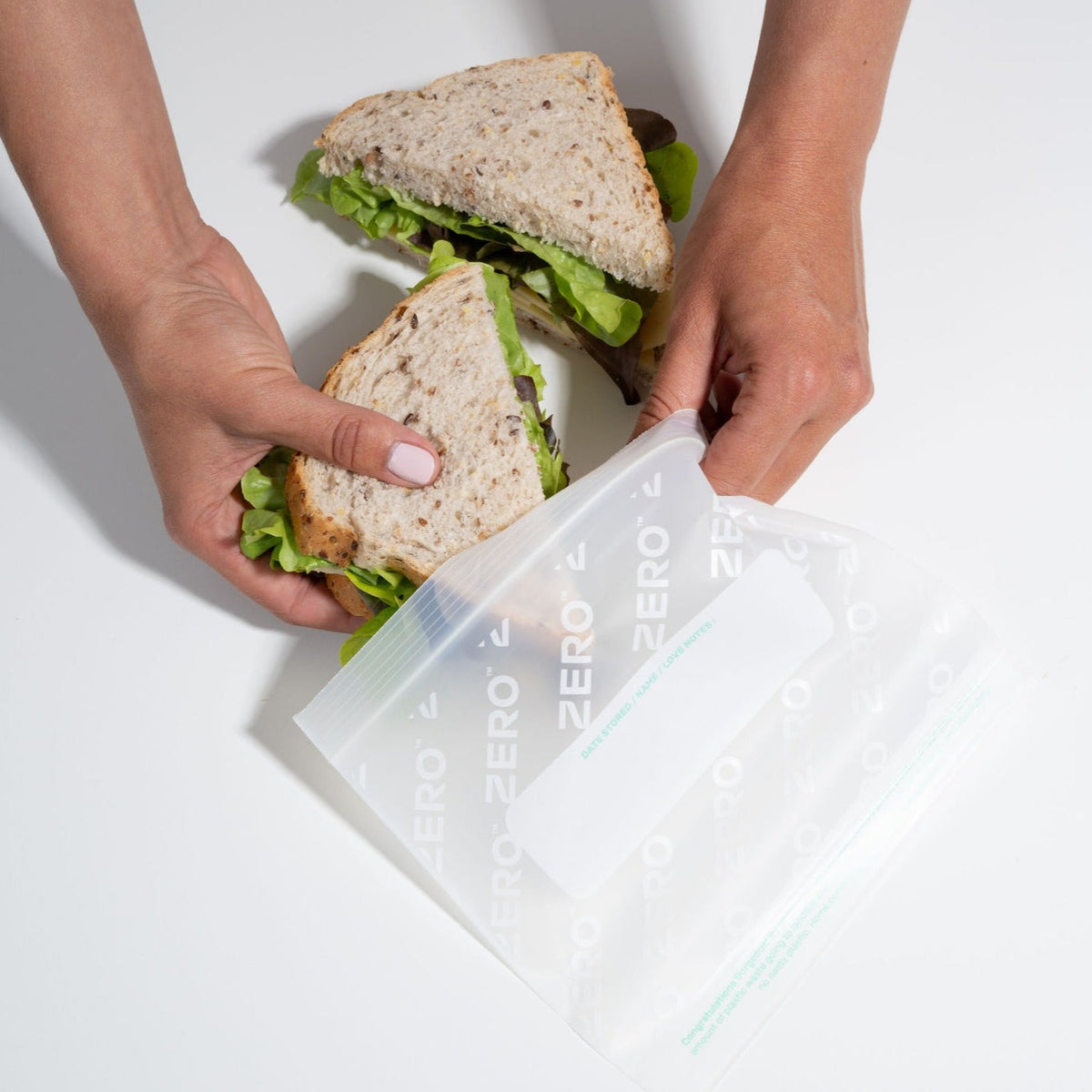
  • Resealable food storage bags — a typical retail product where PBAT provides the soft, flexible feel consumers expect (The Zero Store’s resealable food storage bags use a bio-polymer blend for exactly this reason)
  • Compostable bin liners and produce bags, including plastic-free produce bags designed for organic waste streams

The mulch-film application is worth noting because it is one of the few contexts where in-soil degradation is genuinely the intended end-of-life route, and product grades are engineered accordingly. For most consumer packaging, industrial composting remains the correct disposal path.

Practical pros and cons of PBAT

What PBAT does well:

  • Provides the flexibility that makes thin compostable films and bags commercially viable
  • Certified industrially compostable under EN 13432 and equivalent standards when properly formulated
  • Processes on existing film-extrusion equipment, reducing conversion costs
  • Produces no known toxic residues under proper composting conditions
  • Enables compostable blends that would otherwise be too brittle (PLA-only films crack in cold conditions)

Where it falls short:

  • Most commercial PBAT is still fossil-derived; bio-based PBAT grades exist but remain a small share of supply
  • Costs more than LDPE, which affects price-sensitive packaging decisions.
  • Requires industrial composting for reliable breakdown; home composting is unreliable and marine environments are genuinely problematic
  • “Biodegradable” claims without certification are meaningless for PBAT, as degradation is highly condition-dependent
  • Whole-product certification (inks, adhesives, lamination layers) is not automatic — the polymer may be certified while the finished product is not

When to choose PBAT-blend products: they make sense when you have reliable access to an industrial composting service or council organic waste collection that accepts certified compostable packaging. For items likely to end up in landfill or general waste, the compostability benefit is largely lost.

Pro Tip: Before buying any product labelled “compostable,” check whether your local council’s green-bin or FOGO (food organics and garden organics) service accepts certified compostable packaging. Many Australian councils do, but acceptance varies by region.

How does PBAT compare with PLA and conventional plastics?

Property PBAT (or PBAT blend) PLA LDPE (conventional)
Biodegradability Industrial composting; slow in soil/home compost Industrial composting; brittle at low temps Not biodegradable
Flexibility / elongation High; comparable to LDPE film Low; brittle without modification High
Typical uses Flexible films, bags, mulch, lamination Rigid containers, cups, cutlery, some films Bags, film, shrink wrap, bottles
Key certifications EN 13432, AS 4736, ASTM D6400, OK Compost EN 13432, AS 4736 Recyclable (soft plastics via REDcycle-type schemes)
Cost vs LDPE Higher depending on grade and blend. Higher; varies by grade Baseline

The practical split is straightforward. Choose a PBAT-blend film when you need flexibility and certified compostability — flexible food bags, cling film alternatives, produce bags. Choose PLA for rigid or semi-rigid formats like containers and cups. Stick with LDPE only where durability and conventional recycling are the priority and compostability is not relevant.

One nuance worth flagging: PLA and PBAT blends are not always accepted in the same composting streams. Some industrial composters accept PLA-heavy blends; others prefer higher PBAT ratios. Checking with your local facility before specifying a material is not optional.

Certifications and correct disposal for Australian buyers

The label on a compostable product tells you a lot — if you know what to look for. Here is the checklist:

Certifications to look for:

  • EN 13432 — the European standard covering disintegration, biodegradation, ecotoxicity, and heavy-metal limits; widely used globally and accepted by many Australian composters
  • AS 4736 — the Australian standard for industrial compostability; the local equivalent of EN 13432 and the one most relevant for Australian council FOGO services
  • ASTM D6400 — the US equivalent; accepted by some Australian composters but less common on local labels
  • OK Compost Industrial / Seedling logo — third-party certification by TÜV Austria confirming EN 13432 compliance; look for the green seedling mark
  • OK Compost HOME — a separate, stricter certification for products that genuinely break down in home compost; far fewer products carry this mark

What the label must specify:

  1. Whether the product is certified for industrial or home composting — these are not interchangeable
  2. That the whole product was tested, not just the base polymer (inks, adhesives, and any lamination layers must be included)
  3. The certifying body and certificate number, so you can verify the claim independently

Disposal routes in Australia:

  • Place certified compostable packaging in your council’s FOGO bin if your service accepts it — check your council’s website or call to confirm
  • Some Australian states run commercial composting programmes that accept certified compostable packaging from businesses
  • Do not place PBAT products in soft-plastics recycling streams — they contaminate the melt
  • Do not place them in general waste if a composting route is available; landfill conditions do not support meaningful biodegradation

Understanding the difference between “compostable” and “biodegradable” labels matters here. The Zero Store’s guide on compostable vs biodegradable explains the distinction clearly for Australian consumers.

Who supplies PBAT and where can Australian buyers source it?

PBAT is produced by a relatively small number of global manufacturers and then compounded or converted by a larger network of regional suppliers. Key names in the supply chain:

  • Recent advances in poly(butylene adipate-co-terephthalate) (PBAT): structure, modification strategies, degradation, and sustainable applications
  • Microorganisms and enzymes involved in polybutylene adipate terephthalate biodegradation | Applied Microbiology and Biotechnology | Springer Nature Link
  • Ecoflex® (PBAT)
  • PMC article (research on PBAT and biodegradation)
  • PBAT (Polybutylene Adipate Terephthalate) | Bioplastics Portal
  • Polybutylene adipate terephthalate
  • commonchemistry.cas.org
  • ChEBI: PBAT entry

For Australian packaging buyers and retailers, the practical supply chain typically works like this: a raw PBAT resin is imported from one of the above producers, compounded locally or regionally with PLA or starch to hit the required film specification, then converted into finished film or bags by a film extruder. Requesting the full chain of custody — resin producer, compounder, converter, and certification evidence at each stage — is standard practice for serious procurement.

Sourcing tips for Australian buyers:

  • Request the grade datasheet and confirm the CAS number 130479-65-1 matches the specification
  • Ask for the certification body name, certificate number, and scope (whole product or polymer only)
  • Confirm the grade is suitable for your processing equipment (melt-flow index, film thickness targets)
  • For commercial and hospitality buyers, The Zero Store’s commercial and hospitality collection offers certified compostable products with published specifications

Australian businesses exploring eco-friendly packaging alternatives will find that PBAT-blend films are among the most commercially mature options available today.

What does the science actually say about safety and microplastic risk?

The peer-reviewed picture on PBAT is broadly positive under the right conditions, but it carries important caveats that marketing materials tend to understate.

What the evidence supports:

  • PBAT degrades via ester hydrolysis followed by enzymatic mineralisation; the end products under industrial composting conditions are CO₂, water, and biomass with no known toxic residues
  • The Springer review of microorganisms and enzymes involved in PBAT biodegradation identifies specific thermophilic bacteria and fungal species responsible for the enzymatic breakdown, confirming the biological pathway is well understood
  • BASF’s ecoflex® technical documentation states industrial compostability and cites biodegradation performance under managed conditions

Where uncertainty remains:

  • Degradation in aquatic and cold-soil environments is poorly characterised; the PMC research on PBAT’s environmental fate confirms that microplastic fragment formation is a real risk when conditions are suboptimal
  • Long-term aquatic degradation data is limited; researchers flag this as a significant gap
  • The 2026 Frontiers in Chemistry review of PBAT structure and degradation explicitly calls out microplastic formation and strict degradation conditions as ongoing research priorities

“Compostable describes a potential under managed systems and is not a guarantee for natural environments.” Researchers studying PBAT’s environmental fate consistently emphasise this distinction — the material is not self-disposing in the way that some consumer-facing marketing implies.

The consumer-level implication is direct: PBAT products that end up in waterways or general litter are not meaningfully better than conventional plastic in the short term. The environmental benefit is real, but it is conditional on correct disposal. For a broader look at microplastics in the home, the risks extend well beyond PBAT alone.

How to choose a PBAT product you can actually trust

A buying checklist for consumers and procurement teams:

  1. Check the certification mark — look for EN 13432, AS 4736, or OK Compost Industrial on the label. No mark means no verified claim.
  2. Confirm industrial vs home compost — if the label says “compostable” without specifying, assume industrial only and check your local disposal options before buying.
  3. Request the whole-product test scope — for procurement teams, ask the supplier explicitly: “Does the certification cover the finished product including inks, adhesives, and any lamination layers, or the base polymer only?”
  4. Verify the certificate — TÜV Austria’s OK Compost database and the Australasian Bioplastics Association (ABA) both allow certificate number lookups; use them.
  5. Confirm local composting acceptance — call your council or check their website to confirm your FOGO service accepts certified compostable packaging before specifying it for your business.
  6. Ask for the datasheet and CAS number — a supplier who cannot provide a grade datasheet and the CAS number (130479-65-1 for PBAT) is not a supplier worth using.
  7. Check the blend composition — ask whether the product is PBAT-only or a PBAT/PLA or PBAT/starch blend, and what the certification covers for that specific blend ratio.

Red flags to walk away from:

  • “Biodegradable” with no certification and no timeframe
  • “Compostable” without specifying industrial or home composting
  • No certifying body named on the label or in the product specification
  • Supplier unable to provide a datasheet or certificate number

Pro Tip: For resealable food bags specifically, look for products that carry both the Seedling logo and an explicit statement that the whole bag — not just the film — has been tested. Zippers, seals, and any printed inks all need to be included in the scope.

Key takeaways

PBAT biodegrades reliably only in industrial composting conditions above 50°C; without certified disposal routes, its environmental advantage over conventional plastic is limited.

Point Details
PBAT definition A flexible, biodegradable aliphatic–aromatic copolyester made from adipic acid, 1,4-butanediol, and terephthalic acid.
Composting conditions Industrial composting (>50°C) is required for reliable breakdown; home compost and aquatic environments are unreliable.
Certifications to seek EN 13432 and AS 4736 are the key standards; look for the OK Compost / Seedling mark from TÜV Austria.
Microplastic risk Fragmentation before full mineralisation is possible in cold or aquatic environments; correct disposal is non-negotiable.
The Zero Store Offers certified compostable PBAT-blend resealable bags and household essentials with published specifications for Australian buyers.

The case for being honest about what “compostable” means

Most of the confusion around PBAT comes from a gap between what the material can do and what the label implies it will do. A certified compostable bag is a genuine step forward from conventional LDPE — but only if it reaches an industrial composting facility. Dropped in a bin that goes to landfill, it offers almost no environmental benefit. Ending up in a waterway, it may fragment into microplastics before conditions ever become favourable for full breakdown.

The packaging industry has been slow to communicate this clearly, and some brands have leaned into “compostable” as a marketing shorthand without giving consumers the disposal information they need to make the claim true. That is not a reason to avoid PBAT products. It is a reason to buy them from suppliers who are transparent about certifications, disposal routes, and the limits of the material.

For Australian consumers, the practical path is straightforward: choose certified products (EN 13432 or AS 4736), confirm your council FOGO service accepts them, and use that bin. For procurement teams, demand whole-product certification and a named certificate number before signing off on a specification. The material works. The system around it needs to work too.

The Zero Store’s certified compostable range for Australian households

Resealable Food Storage Bags

The Zero Store was built around exactly this problem: finding household essentials that are genuinely plastic-free, certified compostable, and backed by real specifications rather than vague “eco” claims. The range includes PBAT-blend resealable food storage bags that combine the flexibility you expect from a conventional bag with industrial compostability credentials — no greenwashing, no missing datasheets. Every product on the site lists its bio-polymer composition, relevant certifications, and disposal guidance, so you are not left guessing whether the claim holds up. For Australian households ready to move away from single-use plastics without compromising on practicality, browse the full resealable bags collection and check the product pages for certification details before you buy.

Useful sources and how to verify compostability claims

When evaluating any PBAT product or supplier claim, these are the primary sources worth bookmarking:

When reading a test report, check for four things: disintegration results (does the material physically break down within the test period?), biodegradation percentage (does it meet the 90% threshold required by EN 13432 and AS 4736?), ecotoxicity data (does the compost produced support plant growth?), and scope confirmation (are inks, adhesives, and lamination layers explicitly included?). A report that covers only the base polymer is not sufficient for whole-product certification.

Latest Stories

This section doesn’t currently include any content. Add content to this section using the sidebar.