Degradable plastic fragments into smaller pieces; biodegradable plastic gets broken down by microorganisms into carbon dioxide, water and biomass; compostable plastic has to pass certification tests proving it does this within a set timeframe under specific conditions. They are not interchangeable terms, and mixing them up leads to the wrong bin every time.
- Avoid: anything labelled “degradable” or “oxo-degradable” with no certification standard attached.
- Prefer: products carrying a genuine compostability mark, or better still, something reusable.
- Remember: compostable only works if your local organics service actually accepts it.
Key Takeaways
Compostable is a certified, tested subset of biodegradable, while degradable simply means a material changes physically without any guarantee it fully breaks down.
| Point | Details |
|---|---|
| Definitions differ sharply | Degradable means fragmentation, biodegradable means microbial breakdown, compostable means certified and tested. |
| Environment decides outcome | Industrial composting hits ~90% mineralisation in 180 days; landfill and marine settings behave very differently. |
| Certifications matter most | Look for AS 4736, EN 13432, ASTM D6400 or OK Compost marks rather than the word “biodegradable” alone. |
| Oxo-degradable needs caution | These fragment via additives rather than fully biodegrading, raising microplastic and recycling concerns. |
| Choose reusable where possible | The Zero Store’s produce bags and resealable food storage bags cut single-use waste entirely rather than relying on end-of-life claims. |
Standards and reviews worth checking yourself
- EN 13432 — industrial compostability test specification used across Europe and referenced globally.
- ASTM D6400 / D6868 — the US equivalent compostability standards.
- AS 4736 — Australia’s industrial compostability standard.
- OK Compost / TÜV Austria — third-party certification confirming a product passed testing.
- UK government review of biodegradable plastics standards — independent policy-level evidence review.
Table of Contents
- Degradable vs biodegradable vs compostable: the actual definitions
- How long does it take plastic to break down?
- Which certifications actually prove a product is compostable?
- Why “degradable” claims can do more harm than good
- What to actually buy and how to bin it
- Sources
Degradable vs biodegradable vs compostable: the actual definitions
These three words get used almost interchangeably on packaging, and that’s exactly the problem. Each one describes a different process, with different outcomes for the environment.
Degradable is the loosest term of the three. It simply means a material changes physically or chemically over time, usually through UV exposure, heat, or a chemical additive. It says nothing about what the material breaks down into. A degradable plastic bag might just crumble into smaller and smaller plastic fragments, which is a serious problem in its own right.
Biodegradable means microorganisms, bacteria and fungi, actually consume the material and convert it into carbon dioxide, water and biomass. The UK government’s review of biodegradable plastics standards makes the point clearly: biodegradation depends as much on the disposal environment as it does on the polymer itself. The same material can biodegrade in one setting and sit inert in another.
Compostable is the strictest of the three. It’s a certified subset of biodegradable, meaning the material has passed lab testing proving it breaks down to a set standard within a defined period, usually under industrial composting conditions rather than in your backyard bin.
Oxo-degradable deserves its own mention because it’s the most misleading of the lot. These are conventional plastics dosed with a pro-oxidant additive that speeds up fragmentation. They don’t biodegrade in any meaningful sense; they just break into smaller and smaller pieces, often becoming microplastics rather than vanishing.
| Term | What actually happens |
|---|---|
| Degradable | Physical/chemical breakdown into fragments, no guarantee of full breakdown |
| Biodegradable | Consumed by microbes into CO2, water and biomass, if conditions suit |
| Compostable | Certified to biodegrade fully within a tested timeframe and environment |
A PLA cup stamped with a recognised compostable certification will behave very differently to a polyethylene bag marketed as “degradable” with no standard attached. One has been tested. The other is a marketing claim.
How long does it take plastic to break down?
The environment a product ends up in decides everything. A material tested and approved for industrial composting won’t necessarily do anything useful in landfill or the ocean.
Industrial composting facilities run at thermophilic temperatures, typically 50 to 60 degrees Celsius, with controlled aeration and moisture. That heat is what drives rapid microbial activity.
Home composting runs cooler and far less consistently, and most compostable-certified products are never actually tested for it. The peer-reviewed evidence on biodegradable plastics confirms this variability: materials that mineralise readily under industrial heat can sit largely unchanged in a suburban compost bin.
Landfill is anaerobic, meaning there’s no oxygen. Organic material that would biodegrade nicely elsewhere instead produces methane, a greenhouse gas far more potent than CO2 over a 20-year timeframe. This is why compostable packaging in general waste isn’t a neutral outcome.
Marine and soil environments are the slowest and least predictable of all, with limited microbial activity and no controlled conditions whatsoever.
Standards like EN 13432 and ASTM D6400 set the industrial composting benchmark at roughly 90% biodegradation within 180 days under thermophilic conditions. That’s a lab result. Field performance can differ.
The other distinction worth holding onto: fragmentation is not mineralisation. A plastic can fall apart into invisible pieces and still technically exist as plastic, just now small enough to enter waterways, soil and food chains as microplastic.
Pro Tip: If organic waste, biodegradable or otherwise, ends up in a landfill instead of an organics bin or industrial composter, it can generate methane as it breaks down without oxygen. That’s one more reason council organics collection matters more than the packaging claim itself.

Which certifications actually prove a product is compostable?
Not every green-sounding label means anything. Here’s what to actually look for.
- EN 13432 — the European industrial compostability standard, testing disintegration, biodegradation and toxicity.
- ASTM D6400 / D6868 — the equivalent US standards for compostable plastics and packaging.
- AS 4736 — the Australian standard for industrial compostability, closely aligned with EN 13432’s testing regime.
- OK Compost / TÜV Austria / BPI — third-party certification marks confirming a product has actually passed one of the above tests, rather than just claiming to.
A certified compostable mark means independent testing happened. “Bioplastic”, “eco-friendly” or “degradable” printed on a bag means nothing on their own; bio-based plastic simply refers to the feedstock, and a bio-based polyethylene is chemically identical to the petrochemical version. It will not break down any faster just because it started life as sugarcane.
Before buying, check: the polymer name, the certifying body, whether the disposal instructions specify industrial or home composting, and whether it’s recyclable. Then check your council’s own rules, because certified compostable doesn’t guarantee your organics bin will take it.
Why “degradable” claims can do more harm than good
Vague degradability claims create three problems at once, and none of them are trivial.
The first is microplastics. When a plastic fragments instead of mineralising, it doesn’t disappear; it becomes thousands of smaller plastic particles that persist in soil and waterways. Scientific literature reviewing oxo-degradable plastics found no reliable evidence that fragmentation leads to complete biodegradation in real-world conditions.
The second is recycling contamination. Compostable plastics mixed into a recycling stream can ruin an entire batch of recyclate, and oxo-degradable additives cause similar damage when they end up in conventional plastic recycling.
Regulatory reviews note there is no clear, standardised distinction between oxo-degradable and oxo-biodegradable products in practice, which is part of why the EU’s Single-Use Plastics Directive moved to ban oxo-degradable items outright, citing concerns over microplastics and recycling impacts.
- Microplastic formation from incomplete fragmentation
- Reduced recyclate quality when the wrong plastics mix
- Landfill methane from organics that never make it to composting
- Consumer confusion driving poor bin choices
What to actually buy and how to bin it
Turning all this into a shopping decision is simpler than it sounds once you’ve got the hierarchy straight.
- Reuse first. A reusable produce bag or resealable container beats any single-use option, degradable or not, every single time.
- Recycle if genuinely recyclable. Clean, uncontaminated conventional plastics belong in kerbside recycling, not the compost bin.
- Compost only if certified and accepted locally. Check the item carries AS 4736 or an equivalent mark, and confirm your council’s organics service actually takes it.
- General waste as the last resort. Anything oxo-degradable or unverified should go here rather than risk contaminating compost or recycling streams.
Before checkout, run through this quick checklist:
- Is the polymer named on the pack (PLA, PBAT, PHA)?
- Is there a certification body or number, not just a logo?
- Are disposal instructions specific (industrial composting, home composting, landfill)?
- Does your council’s organics collection actually accept certified compostables?
Products such as resealable food storage bags designed for repeated use sidestep this whole decision tree, which is worth factoring in before you reach for anything single-use.
How do you verify a product’s environmental claims?
Look past the front-of-pack claim and check the fine print. A trustworthy product page states the polymer identity, names the certifying body rather than just showing a green leaf icon, and gives disposal instructions specific enough to act on.
- Polymer ID (PLA, PBAT, PHA, or conventional plastic with an additive)
- Named certifier and, ideally, a certificate number
- Disposal guidance that names the environment (industrial composting, general waste)
- Any third-party lab test referenced, not just self-declared claims
The Zero Store’s own product specification pages are built around this level of detail because vague claims help nobody sort their bin correctly. Transparency beats a marketing adjective every time.
A practical approach to buying and vetting products
We’d rather buy less and buy better: reusable where reuse is realistic, certified compostable where it isn’t, and always with the polymer and certification spelt out. Transparent product specs aren’t a nice extra. They’re the only way shoppers can trust a claim.
Where plastic-free alternatives fit into this
There are genuine trade-offs between degradable, biodegradable and compostable products, and none of them beat simply avoiding single-use plastic altogether. That’s the gap The Zero Store was built to fill: household essentials designed for reuse or genuine, certified composting, with the polymer and certification stated plainly on every product page rather than buried in fine print.
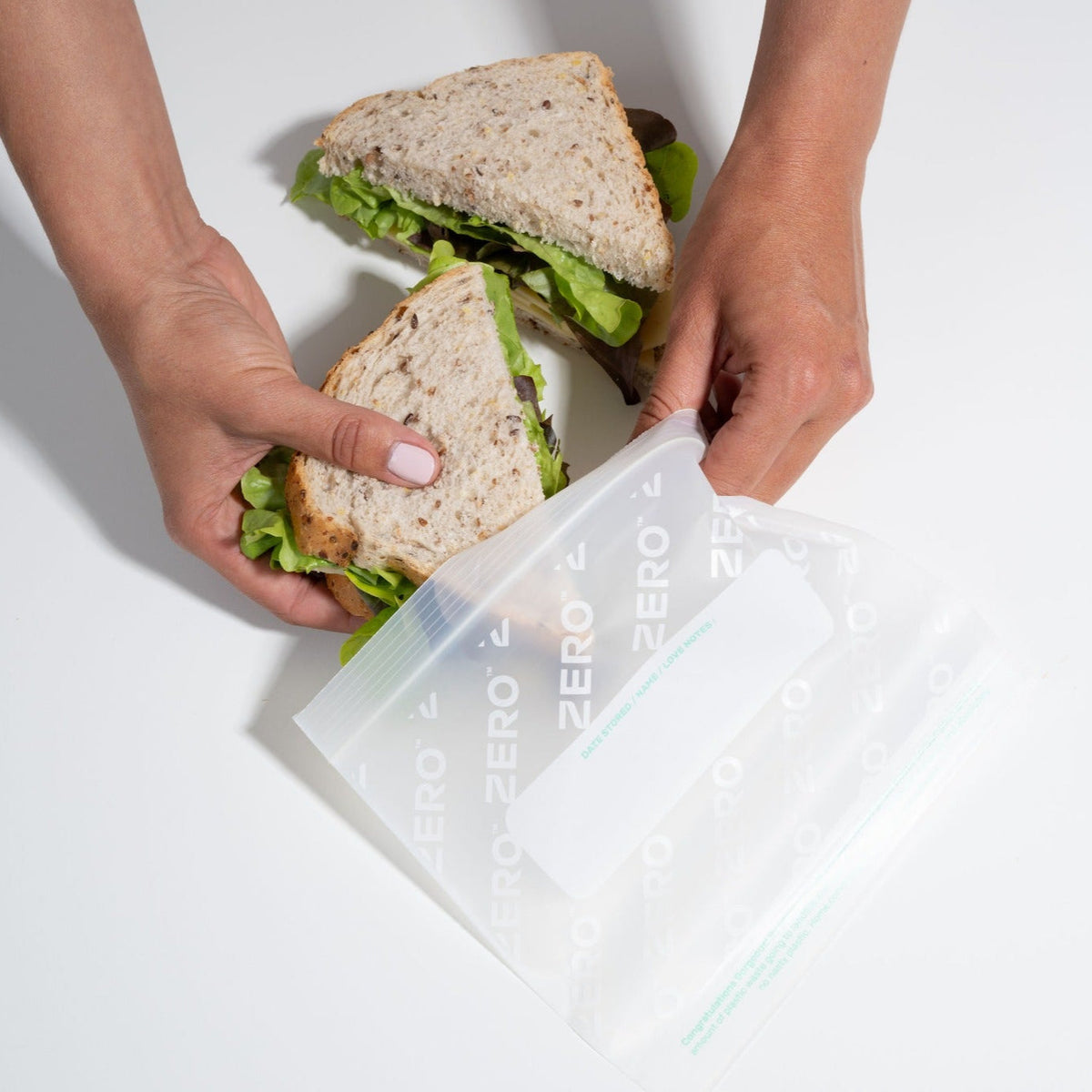
If you’re replacing single-use produce bags, the Plastic Free Produce Bags (2 Pack) are made to be reused for years rather than once. For food storage, the Resealable Food Storage Bags offer a plastic-free alternative to zip-lock bags without the fragmentation risk that comes with oxo-degradable versions. Check either product page for the polymer breakdown and disposal guidance before you buy, and pick the option that actually fits your household’s waste system.
Sources
- A review of standards for biodegradable plastics (UK government / IBioIC)
- Compostable and biodegradable plastics (RSC explainer)
- BIODEGRADABLE PLASTICS: Review of scientific literature on oxo‑degradable plastics
- Biodegradable plastics and compostability: evidence and standards (peer‑reviewed overview)


Share:
No, biodegradable wipes flushable claims don't hold up in testing
Cling wrap BPA: what health‑conscious buyers should know